
You can speak useful Thai phrases within days and hold a basic conversation within a few months. That’s not a motivational claim — it’s a realistic outcome when you follow a speaking-first plan built around the right priorities.
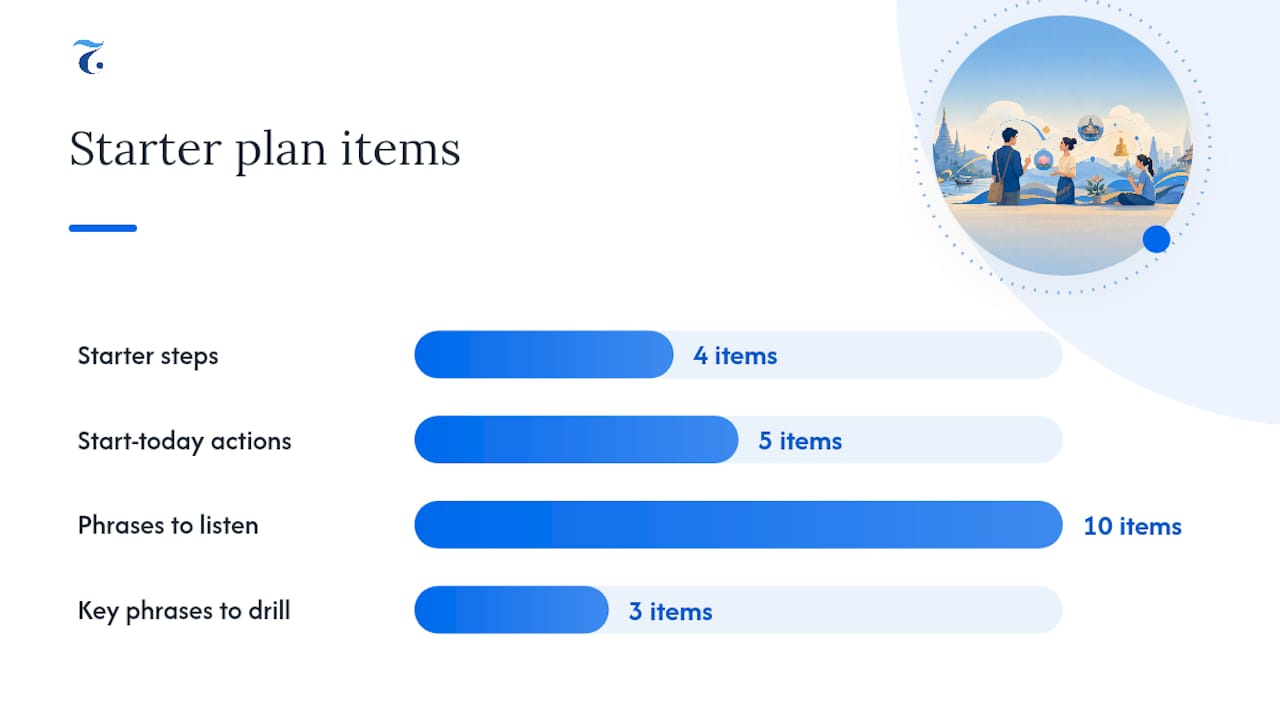
Here’s your four-step starter plan:
- Listen first. Before you try to speak, train your ear on native audio. Thai tones are the single biggest obstacle for English speakers, and your brain needs exposure before your mouth can cooperate.
- Copy, don’t translate. Imitate phrases exactly as a native speaker says them. Don’t construct sentences from grammar rules yet.
- Add polite particles immediately. “Khrap” (male speakers) and “kha” (female speakers) go at the end of almost every sentence. Using them from day one signals respect and gets you a warmer response.
- Record yourself and compare. Play back your recording against a native model. The gap you hear is your practice target.
Start today with these five actions:
- Pull up a free audio lesson on Loecsen’s Thai beginner course and listen to the first ten phrases without reading along.
- Write out “Sawasdee khrap/kha” (hello), “Kob khun khrap/kha” (thank you), and “Khor thot khrap/kha” (excuse me) on a card and say each one ten times.
- Record yourself saying those three phrases and compare to the audio.
- Find one Thai YouTube video and shadow a single sentence until your version sounds close.
- Set a 15-minute daily practice block in your calendar for the next seven days.
Chulalongkorn University’s guidance on Thai for non-native speakers confirms this approach: prioritize listening and speaking, imitate native speakers, and hold off on complex grammar until you have a working phrase bank. Thai Explorer’s structured courses follow the same communicative-first logic, with native bilingual instructors and a curriculum aligned to recognized Thai-teaching standards.
Key Takeaways
Speaking Thai is achievable for any adult learner who follows a speaking-first plan built around tone training, polite particles, and consistent daily practice with real feedback.
| Point | Details |
|---|---|
| Start with tones and particles | Train your ear on all five tones and add khrap/kha to every sentence from day one. |
| Use a phrase bank immediately | Ten fully owned phrases beat a hundred half-remembered ones; start with greetings, ordering, and directions. |
| Follow the 8-week plan | Weekly milestones from tone recognition to spontaneous conversation give you measurable targets. |
| Get real feedback | Record yourself weekly, compare to native audio, and use a tutor or instructor for tone correction. |
| Thai Explorer for structured progress | Native bilingual instructors, CU-TFL-aligned curriculum, and live Zoom classes suit busy adult learners. |
Table of Contents
- What makes Thai speaking different from English?
- Starter phrases you can use today
- How to drill tones and tricky sounds
- What does an 8-week speaking plan look like?
- Where should you practice and what resources actually help?
- How do you get feedback and measure real progress?
- Common mistakes and how to stay polite
- Why does a structured course speed up your speaking progress?
- Thai Explorer’s online courses for adult learners
- Sources
- FAQ
What makes Thai speaking different from English?
Thai is a tonal language. That single fact changes everything about how you should learn it. The same syllable spoken with five different pitches produces five different words with completely unrelated meanings. Mispronounce a tone and you haven’t just made an accent error — you’ve said the wrong word entirely. Wikipedia’s Thai language overview classifies Thai as a Kra-Dai language with a tonal system that has no parallel in English, French, or Spanish.
The five tones are mid, low, falling, high, and rising. English speakers tend to hear them as emotional inflection at first, which is why ear training has to come before speaking practice. You can’t produce what you can’t yet hear.
Politeness particles: khrap and kha
Thai has no verb conjugation for politeness the way French or German does. Instead, you add a single syllable to the end of your sentence. Male speakers say “khrap” (often written “krub”); female speakers say “kha.” According to Chulalongkorn University’s practical guidance, these particles soften tone and are expected in any interaction with strangers, service staff, or anyone in a professional context. Skip them and you sound blunt, even rude, regardless of what words you chose.
There’s also no direct equivalent of “please” in Thai. Politeness comes from particle use and register choice, not a single magic word. The safest beginner strategy: use khrap or kha on every sentence until you develop a feel for when casual speech is appropriate.
Pro-drop and sentence structure
Thai is a pro-drop language, meaning pronouns like “I” and “you” are routinely omitted when context makes them obvious. Beginners who translate directly from English tend to overuse pronouns and sound unnatural. The fix is simple: learn phrases as complete units rather than building sentences word by word.
Thai script uses 44 consonant letters, many of which represent similar sounds and are distinguished by example words — a system the BBC’s Thai alphabet guide describes as naming each letter by a reference word (for example, ก is “gor gai,” the letter of the word for chicken). You don’t need to read Thai to start speaking it, but knowing this naming system helps when a teacher spells out a sound for you.
Three immediate priorities for any beginner:
- Train your ear on tones before you try to produce them.
- Add khrap or kha to every sentence from your first day.
- Learn phrases as whole units — imitate, don’t construct.
Starter phrases you can use today
The fastest way to feel confident in Thai is to own a small set of phrases completely. Ten phrases you can say naturally beat a hundred you half-remember.
Greetings and basic responses
- Sawasdee khrap/kha — Hello / Goodbye (use for both)
- Sabai dee mai khrap/kha? — How are you?
- Sabai dee khrap/kha — I’m fine / I’m well
- Kob khun khrap/kha — Thank you
- Khor thot khrap/kha — Excuse me / I’m sorry
- Mai pen rai khrap/kha — No problem / Never mind
- Chai khrap/kha — Yes
- Mai chai khrap/kha — No
- Pood Thai mai dai khrap/kha — I can’t speak Thai (useful safety phrase)
The Hot Thai Kitchen traveler’s phrase guide recommends this exact core set as the highest-value first targets for anyone spending time in Thailand or communicating with Thai speakers.
Transactional phrases for real situations
Ordering food:
- Ao [dish name] khrap/kha — I’ll have [dish name]
- Aroy mak khrap/kha — Very delicious
- Check bin khrap/kha — The bill, please
- Phet nit noi khrap/kha — A little spicy, please
Asking price / shopping:
- Tao rai khrap/kha? — How much is it?
- Phaeng pai khrap/kha — That’s too expensive
- Lot noi dai mai khrap/kha? — Can you lower the price a little?
Asking for directions:
- [Place name] yoo tee nai khrap/kha? — Where is [place name]?
- Pai [place name] yang ngai khrap/kha? — How do I get to [place name]?
Emergency:
- Chuay duay khrap/kha! — Help!
- Riak rot payaban duay khrap/kha — Please call an ambulance
Pro Tip: Drop the pronoun. Instead of “I want to order pad thai,” just say “Ao pad thai khrap/kha.” It’s shorter, sounds more natural, and Thai speakers will understand you immediately.
Two quick roleplay scripts
Ordering food (beginner script):
You: “Sawasdee khrap/kha.”
Staff: “Sawasdee kha. Ao arai khrap?”
You: “Ao pad kra pao moo khrap/kha. Mai phet mak khrap/kha.”
Staff: “Dai leuy kha.”
You: “Kob khun khrap/kha.”
Asking for directions:
You: “Khor thot khrap/kha. BTS [station name] yoo tee nai khrap/kha?”
Local: “Trong pai leuy kha.”
You: “Kob khun mak khrap/kha.”
Practice each script ten times until the words come out without thinking. That automaticity is the goal.
How to drill tones and tricky sounds
Tones are a physical skill, not just an intellectual one. You build them the same way a musician builds scales: repetition, listening, and immediate feedback. Here’s a five-step drill sequence you can run in 15 minutes.
Five progressive tone drills
- Minimal-pair listening. Find audio of Thai words that differ only in tone (for example, “maa” meaning “come,” “horse,” or “dog” depending on tone). Listen to each pair ten times without trying to repeat. The goal is recognition, not production.
- Shadowing. Play a short native-speaker sentence and speak along simultaneously, matching pitch and rhythm as closely as possible. Don’t worry about meaning yet. Focus on the melody of the sentence.
- Record and compare. Say the same sentence alone, record it, then play your version back-to-back with the native model. Listen for where your pitch diverges.
- Isolate the problem tone. If your falling tone sounds flat, drill that tone alone using five different words. Exaggerate the pitch drop until it feels unnatural — that exaggeration is usually closer to correct than your instinct.
- Reintegrate into a phrase. Once the isolated tone sounds right, put it back into a full sentence and record again.
For detailed drills built specifically for this sequence, Thai Explorer’s tone exercise guide walks through five structured practice sets with audio reference points.
Consonant sounds English speakers struggle with
Thai has aspirated and unaspirated consonant pairs that English speakers often collapse into one sound. The difference between “p” in “pai” (to go) and “ph” in “phet” (spicy) is airflow: hold your hand in front of your mouth and feel for a puff of air on the aspirated version. No puff means unaspirated. Practice this distinction with a piece of paper — it should flutter for aspirated stops and stay still for unaspirated ones.
The “ng” sound at the start of a word (as in “ngaan,” meaning work) has no English equivalent at the start of a syllable. English speakers can produce it at the end of words (“sing,” “ring”) but not the beginning. Practice by humming “ng” and then opening into a vowel without stopping the nasal resonance.
Daily micro-practice schedule
- Daily (10–15 minutes): One minimal-pair drill, one shadowing pass on a new sentence, one recording review.
- Three times per week (20–30 minutes): Full five-step drill sequence on a new set of tones, plus roleplay of one phrase scenario.
- Weekly (45–60 minutes): Full review session: replay recordings from the week, identify the most persistent error, and drill it in isolation.
Pro Tip: Use your phone’s voice memo app, not a dedicated recording setup. The friction of a simple tap-to-record is low enough that you’ll actually do it every day. Anything more complicated and you’ll skip it.
What does an 8-week speaking plan look like?
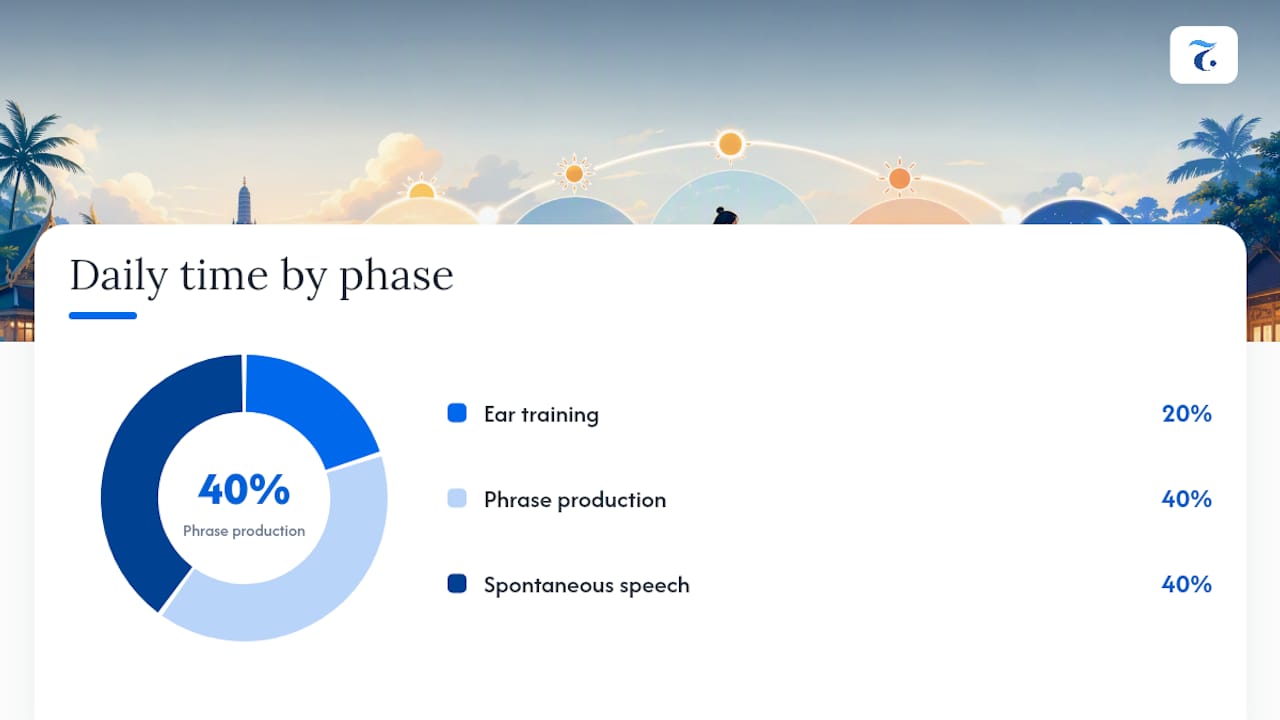
A realistic eight-week plan for Thai language beginners builds from ear training to phrase production to spontaneous speech. The TPA Thai Language Proficiency Test maps non-native ability from T1 (Beginner) through T5 (Proficient); the goal of this plan is to move you solidly into T1 territory with the foundations for T2 work.
| Week | Focus | Daily Time | Milestone |
|---|---|---|---|
| 1 | Tone recognition + core 10 phrases | 15 min | Identify all five tones by ear |
| 2 | Greetings + polite particles in use | 15 min | Greet someone and respond naturally |
| 3 | Food and ordering phrases | 20 min | Order a full meal in Thai |
| 4 | Directions and location phrases | 20 min | Ask for and follow basic directions |
| 5 | Shopping and numbers | 20 min | Ask price, negotiate, and pay |
| 15 minutes | Shadowing + spontaneous phrase recall | 15-minute session | Hold a 2-minute scripted conversation |
| — | Emergency and help phrases + review | 15-minute session | Handle a simulated emergency scenario |
| 8 | Free conversation practice + self-test | 30 min | Complete a self-recorded conversation test |
Adapting for a busier schedule: If 15–20 minutes daily isn’t realistic, compress to three focused 30-minute sessions per week and extend the plan to 12 weeks. The milestones stay the same; the timeline stretches. What doesn’t work is skipping days and trying to catch up in weekend marathons — spaced repetition beats cramming for language retention every time.
For a step-by-step pronunciation foundation that supports weeks 1–3, the beginner pronunciation guide at Thai Explorer covers the exact sounds you’ll encounter in those early phrases.
Key milestones to track:
- Week 3: Order a meal in Thai without switching to English
- Week 5: Ask for a price and understand the number in the response
- Week 8: Record a two-minute self-introduction and play it back without cringing at the tones
Where should you practice and what resources actually help?
The single most important quality in any Thai learning resource is audio quality with a native speaker model. Everything else is secondary. Here’s how to think about each resource type.
Audio-first beginner courses
Free audio-based courses like Loecsen’s Thai beginner lessons use a listen-then-repeat structure that gets you to a CEFR A1-like level with consistent short daily practice. The method works because it trains your ear and mouth simultaneously, using real sentences rather than vocabulary lists. A 15-minute session: listen to five new phrases, shadow each three times, record yourself on the last pass.
YouTube and shadowing content
YouTube is genuinely useful for Thai speaking practice if you use it actively rather than passively. Search for “Thai conversation for beginners” or “Thai shadowing practice” and find a video with clear audio and on-screen romanization. Watch once for comprehension, then shadow the audio on a second pass. The key is to speak along, not just listen.
Language exchange and tutors
A language exchange partner (a Thai speaker learning English) gives you free real-time practice. Apps like Tandem or HelloTalk connect you with native speakers. The limitation is consistency — exchanges depend on both parties showing up. For structured feedback, a paid tutor on a platform like iTalki gives you a native speaker who can correct your tones in real time.
Thai Explorer: instructor-led online classes
For adult learners who want faster, more structured progress, Thai Explorer’s online courses deliver live Zoom classes with native bilingual instructors. The curriculum aligns with CU-TFL standards, which means your progress maps to a recognized framework rather than an arbitrary course sequence. Group classes give you peer conversation practice; private sessions let you focus on your specific weak points, whether that’s tones, vocabulary, or spontaneous speech.
Pro Tip: Whatever resource you use, spend at least half your session time speaking out loud, not reading or listening. Passive exposure builds comprehension; active production builds speaking ability. They are not the same skill.
Free vs. paid resources by level
- Absolute beginners: Start free. Loecsen’s audio course, YouTube shadowing content, and the phrase bank in this article give you everything you need for weeks 1–4.
- Intermediate (post-week 4): A structured course or regular tutor sessions become worth the investment. At this stage, you need real-time feedback on tones and grammar patterns that free resources can’t reliably provide.
How do you get feedback and measure real progress?
Most learners practice in a vacuum and wonder why they plateau. Feedback is the mechanism that turns practice into improvement.
Simple metrics to track weekly
- Comprehension rate: Play a short native-speaker audio clip. How much do you understand without reading a transcript? Track this percentage weekly.
- Phrase recall speed: Time yourself saying your ten core phrases from memory. If it takes more than three seconds per phrase, you need more repetition.
- Being understood: In a real or simulated conversation, how often does your listener understand you without asking for clarification? Aim for 80% or better by week 8.
Building a feedback loop
Record a two-minute speaking sample every Friday. Listen back on Saturday and note your two most consistent errors. Drill those errors specifically in the following week. Bring the recording to a tutor session and ask for targeted correction on those same two points. This cycle — record, identify, drill, verify — is faster than any other improvement method because it focuses your practice on actual weaknesses rather than comfortable repetition of what you already know.
Common mistakes and how to stay polite
Most early mistakes in Thai fall into two categories: tone errors that change meaning, and politeness errors that create awkward social situations. Both are fixable with a short list of do/don’t rules.
Pronunciation and tone traps
- Don’t use rising intonation as a question marker the way English does. Thai questions use particles like “mai” or “rue,” not a rising pitch at the end.
- Don’t flatten all five tones into two or three. The falling tone and the low tone sound similar to English ears but are distinct in Thai.
- Do exaggerate tones in practice. Your instinct to moderate pitch is an English habit; fight it deliberately until the Thai pitch range feels natural.
- Don’t stress syllables the way English does. Thai syllable stress is more even; over-stressing makes you harder to understand.
Politeness mistakes and safe defaults
- Don’t skip khrap/kha with service staff, strangers, or anyone older than you. The social cost is real.
- Don’t use “rao” (we/I, informal) in formal settings. Default to the more neutral “phom” (male) or “chan” (female) for “I” when a pronoun is needed.
- Do smile. Thai communication is high-context, and a genuine smile with an imperfect phrase lands far better than a grammatically correct sentence delivered flatly.
- Don’t point at people with your foot or touch someone’s head — these are serious cultural violations that no amount of polite Thai will fix.
Pro Tip: In markets and taxis, a simple “Tao rai khrap/kha?” (How much?) followed by a smile gets you further than any elaborate negotiation phrase. Thais appreciate the attempt to speak Thai, and that goodwill is worth more than perfect grammar.
Situational tips
Restaurants: Always greet staff with “Sawasdee khrap/kha” before ordering. It sets a polite tone and often gets you better service.
Taxis: Confirm the destination before you get in. “Pai [place] dai mai khrap/kha?” (Can you go to [place]?) avoids confusion and shows you know the basics.
Workplace: Use formal register with anyone senior to you. When in doubt, add khrap/kha and use the more formal pronoun.
Why does a structured course speed up your speaking progress?
Self-study gets you started. A structured course gets you further, faster. The difference is systematic feedback and a progressive syllabus that builds each skill on the last.
Here’s what structured instruction gives you that self-study doesn’t:
- Guided tone correction in real time. A native instructor hears your pitch errors immediately and corrects them before they become habits. Bad tone habits are much harder to unlearn than they are to prevent.
- A speaking-first curriculum. Good courses sequence speaking exercises before grammar explanation, which mirrors how children acquire language and how adults retain it best.
- Measurable milestones. A structured course tied to a recognized framework like CU-TFL gives you objective benchmarks, not just a feeling of progress.
- Accountability. Scheduled classes create a practice cadence that self-study rarely sustains past week three.
How Thai Explorer works for US-based adult learners
Thai Explorer delivers live Zoom classes, which means time zone is the main scheduling consideration for US-based learners. Singapore Standard Time (SST) is 11–12 hours ahead of US Eastern time, so evening classes in Singapore correspond to morning slots in the US. Early morning Singapore classes align with US evening hours. The school offers both group and private formats, so you can choose peer conversation practice or one-on-one instruction depending on your schedule and learning style.
The curriculum aligns with CU-TFL standards, giving your progress a recognized reference point. Instructors are native Thai speakers who are bilingual in English, which matters practically: when you don’t understand a correction, you can ask for it in English and get a clear answer rather than a demonstration you have to guess at.
For in-person learners based in Singapore, the school is located at 10 Anson Road, #22-07, International Plaza, Singapore 079903, right above Tanjong Pagar MRT.
Trial classes are available, which is the right way to evaluate any language course. One session tells you more about instructor quality and teaching style than any description can.
The real reason to start speaking Thai before you’re ready
There’s a common fear that speaking too early will cement bad habits. The evidence doesn’t support it. What cements bad habits is practicing alone with no feedback. Speaking early, with a qualified instructor or a patient native speaker, surfaces errors while they’re still easy to correct.
Locals respond warmly to genuine attempts to speak Thai. That positive feedback loop is not a small thing. It creates real-world practice opportunities that accelerate progress in ways no app or textbook can replicate. The learner who speaks imperfect Thai in a market conversation gets more practice in five minutes than the learner who spends an hour reviewing flashcards.
Treat Thai speaking as a social skill, not a grammar test. You don’t need to be correct. You need to be understood, and you need to keep going.
Thai Explorer’s online courses for adult learners
Thai Explorer offers a direct path from zero to conversational Thai for adult learners who want structured progress without the guesswork of self-study.

What the courses include:
- Live Zoom classes with native bilingual instructors
- Group and private formats to fit your schedule and budget
- Conversational and business Thai tracks
- Curriculum aligned with CU-TFL standards for measurable progress
- In-person option at 10 Anson Road, #22-07, International Plaza, Singapore 079903 (above Tanjong Pagar MRT)
The fastest way to find out if it’s right for you is a trial class. Browse course formats and book a session to get started with a native instructor who can assess your current level and map out exactly what you need to work on.
Sources
- Quick Win: Mastering the Thai Language – Chulalongkorn University
- Thai Language Lesson for Travelers – The Basics
- TPA Thai Language Proficiency Test
- The best Thai course for beginners | Free
- BBC – Languages – Thai – A Guide to Thai – The Thai alphabet
- Thai language
FAQ
Is Thai language easy to speak?
Thai is moderately challenging for English speakers, mainly because of its five-tone system and the absence of any shared vocabulary with English. Most learners can produce basic, useful phrases within days of focused practice.
What are some basic Thai words to learn first?
Start with “Sawasdee khrap/kha” (hello), “Kob khun khrap/kha” (thank you), “Khor thot khrap/kha” (excuse me), and “Mai pen rai khrap/kha” (no problem). These four phrases cover the majority of polite everyday interactions.
How do you say “hi” in Thai?
“Sawasdee khrap” (male speaker) or “Sawasdee kha” (female speaker) is the standard greeting for both hello and goodbye. The polite particle at the end is not optional in most social contexts.
How do you say “I love you” in Thai?
“Phom rak khun” is used by male speakers; “Chan rak khun” is used by female speakers. In casual speech between close friends or partners, the pronouns are often dropped and speakers simply say “Rak khun.”
How long does it take to start speaking Thai fluently?
Basic conversational ability typically develops within 8–12 weeks of daily focused practice. The TPA proficiency framework maps beginner (T1) through proficient (T5) levels; reaching T2 functional conversational ability generally takes several months of consistent study, faster with instructor-led feedback.