
TL;DR:
- Structured online courses and consistent practice are key to learning Thai effectively.
- Mastering tones requires daily exercises and AI tools for accurate pronunciation.
- Personal accountability and regular feedback drive long-term progress in Thai fluency.
Learning Thai from Singapore sounds exciting until you realize you’re juggling work schedules, limited access to native speakers, and the sheer complexity of a tonal language. The good news? Structured online learning has fundamentally changed what’s possible for learners here. Whether you’re preparing for your next trip to Bangkok, building professional connections in Thailand, or simply falling in love with Thai culture, this guide walks you through everything: what to set up, how to follow a proven process, how to master tones, and how to track real progress without losing steam.
Table of Contents
- What you need to start learning Thai online
- Step-by-step process: how to learn Thai online effectively
- Mastering Thai pronunciation and tones online
- Tracking progress and avoiding common mistakes
- Why personal accountability is the real secret to online Thai fluency
- Take the next step: start learning Thai online with expert guidance
- Frequently asked questions
Key Takeaways
| Point | Details |
|---|---|
| Start with clear goals | Setting specific learning objectives helps you stay motivated and track progress when learning Thai online. |
| Choose CEFR-based courses | Pick online courses aligned with CEFR levels for reliable structure and measurable improvement. |
| Practice tones daily | Mastering Thai pronunciation and tones is essential—dedicate a few minutes each day to targeted practice. |
| Use AI tools and feedback | Let technology like AI-driven pronunciation practice guide you toward clearer Thai speech. |
| Track your progress | Regular self-assessment and online tests make sure you’re truly advancing toward Thai language fluency. |
What you need to start learning Thai online
Having set the stage, let’s get clear on what you should have in place before you start. Jumping into an online Thai course without the right foundation is like trying to run before you can stand. A little preparation upfront saves you hours of frustration later.
Technical requirements
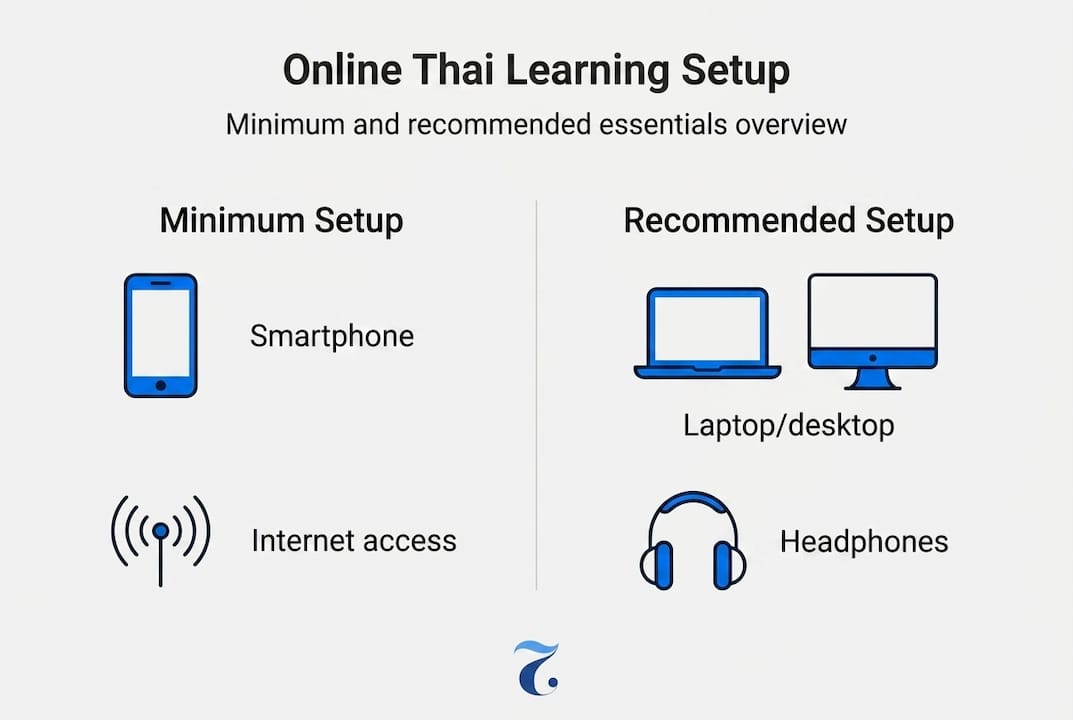
First, let’s cover the basics. You’ll need a reliable device, ideally a laptop or desktop rather than a phone, because reading Thai script on a small screen is genuinely painful. A stable internet connection matters more than most learners expect. Live lessons with a native instructor can lag or drop at critical moments if your connection is weak, so aim for at least 10 Mbps. A decent headset with a built-in microphone is non-negotiable for pronunciation practice. Tones in Thai are everything, and your instructor needs to hear exactly what you’re producing. Earbuds with a microphone can work, but a USB headset gives you much better audio clarity.

Platforms and course structures
Not all online Thai courses are created equal. Some are purely app-based with gamified lessons, which can be fun but often lack depth. Others are structured courses with live instructor feedback, which tends to produce faster, more accurate results. ThaiPod101 provides lessons from absolute beginner to advanced, using real-world audio and video podcasts on conversations, vocabulary, and grammar, with pathways aligned to CEFR levels A2-B2 that emphasize listening and speaking. That makes it a solid supplementary tool, though it works best alongside live instruction rather than as a standalone program.
Speaking of CEFR, understanding CEFR proficiency levels before you enroll helps you choose a course that genuinely matches where you are, not where you think you are. Many learners accidentally enroll in courses that are too easy or too challenging, which kills momentum fast.
Explore your online Thai course options early so you understand the full range available, from beginner group classes to advanced private sessions.
Your starter checklist
Before your first lesson, confirm you have:
- A laptop or desktop with a stable internet connection
- A headset or quality USB microphone
- A dedicated notebook for Thai script practice
- A learning schedule with at least three sessions per week
- A clear goal (travel, professional use, or cultural appreciation)
- An honest self-assessment of your current level
Pro Tip: Before enrolling, ask the course provider for a short placement quiz or a trial lesson. If neither is available, try completing a free beginner unit on a reputable platform first. This gives you a realistic sense of pace and difficulty before you commit financially.
| Requirement | Minimum standard | Recommended standard |
|---|---|---|
| Device | Smartphone | Laptop or desktop |
| Internet speed | 5 Mbps | 10 Mbps or above |
| Audio setup | Phone speaker/mic | USB headset with microphone |
| Study sessions per week | 2 | 3 to 5 |
| Course alignment | Self-paced app | CEFR-aligned structured course |
Step-by-step process: how to learn Thai online effectively
With all the essentials ready, let’s walk through how to actually master Thai online, one step at a time. Having a clear process prevents you from bouncing between random apps and YouTube videos without actually progressing.
Step 1: Explore and set your learning goal
Before you enroll anywhere, define what success looks like for you. Conversational Thai for travel is a very different goal than business Thai for meetings in Bangkok. Your goal shapes everything: course type, pace, and the vocabulary sets you prioritize. Write your goal down. Seriously. Learners who articulate a specific goal are significantly more likely to complete their courses.
Step 2: Enroll in a structured course
Self-discovery learning has its place, but for Thai, structure accelerates results. Enroll in a course that sequences grammar, vocabulary, and script practice rather than leaving you to figure out the order yourself. A structured Thai course ensures you build each skill layer on a solid foundation before adding complexity.
Step 3: Build a fixed schedule and protect it
Consistency beats intensity every time in language learning. Three 45-minute sessions per week, maintained over six months, outperforms a frantic weekend binge followed by two weeks of nothing. Block your study time in your calendar and treat it like a meeting you cannot cancel.
Step 4: Practice beyond lessons
Active use between lessons accelerates retention dramatically. Listen to Thai podcasts, watch Thai dramas with subtitles, and try speaking aloud even when no one is listening. The goal is to make Thai part of your daily mental environment, not just a weekly study task.
Step 5: Seek feedback and adjust
Regular feedback from a qualified instructor catches errors before they become habits. Bad pronunciation habits in particular are very difficult to unlearn. Check out our Thai learning tips to understand how to get the most from each lesson and how to spot whether your current approach is working.
Step 6: Review and adapt your plan every month
Every four weeks, look at what’s working and what isn’t. Are you hitting your vocabulary targets? Can you handle simple conversations? Adjust your study sessions accordingly, adding more speaking practice if listening comprehension is strong but output is lagging.
ThaiPod101 reviews highlight that tutoring offers personalized feedback while self-paced learning provides flexibility, but note that motivation challenges without accountability are the most common reason learners stall on self-paced platforms.
| Learning mode | Key strengths | Key limitations |
|---|---|---|
| Live tutoring | Personalized, immediate feedback | Can be costly, schedule-dependent |
| Self-paced course | Flexible, affordable, revisitable | Lower accountability, less feedback |
| Blended (tutoring + self-paced) | Best of both worlds | Requires more planning and discipline |
Pro Tip: Pair every live lesson with a 20-minute self-study review the following morning. Reviewing material within 24 hours dramatically improves long-term retention, a principle backed by spaced repetition research.
Mastering Thai pronunciation and tones online
One hurdle for many is perfecting Thai pronunciation. Let’s demystify how you can conquer this online, because tones are genuinely the make-or-break factor in Thai communication.
Thai has five tones: mid, low, falling, high, and rising. The same syllable spoken in different tones can mean completely different things. The classic example: “mai” can mean “new,” “burn,” “not,” “silk,” or a question particle depending on the tone. Getting tones wrong isn’t just imprecise. It can cause genuine confusion or unintended meaning.
Why online tools help more than you might expect
The common concern is that you can’t learn tones without sitting in front of a native speaker every day. That’s less true than it used to be. AI tools improve pronunciation in tonal languages significantly by giving learners real-time audio feedback that helps them hear and correct pitch patterns they might otherwise miss entirely. Platforms that incorporate AI-driven pronunciation analysis allow you to repeat a tone until your pitch matches the target model, which is something a classroom environment with 10 or more students simply can’t provide at scale.
Daily tone drills that work
Tones require muscle memory, not just intellectual understanding. You need to practice them daily, not just during formal lessons. Build these habits:
- Spend 10 minutes each morning listening to native Thai audio and mimicking tone patterns out loud
- Record yourself reading Thai words or short sentences and compare your recording to a native speaker’s version
- Use flashcard apps like Anki with audio on both sides of the card so you hear the correct tone during every review
- Practice Thai tone exercises specifically designed to isolate each of the five tones before using them in conversation
- Shadow Thai TV show dialogue for at least five minutes daily, focusing on rhythm and pitch rather than word meaning
The biggest mistake with tones
Most learners try to intellectualize tones by memorizing rules. Rules help as a starting point, but fluency in tones comes from ear training. You need to hear the difference between a falling tone and a high tone thousands of times before your brain stops consciously thinking about it. AI tools accelerate this exposure by creating an almost unlimited practice environment outside your scheduled lessons.
Think of it like learning a musical instrument. You can read all the theory you like, but until your fingers have played the chord a hundred times, theory is just theory.
Tracking progress and avoiding common mistakes
After building your skills, it’s crucial to measure real progress and refine your approach for steady gains. Many learners feel busy without actually moving forward, and the difference usually comes down to honest self-assessment.
Using CEFR levels to measure where you are
CEFR levels (A1 through C2) give you a reliable, internationally recognized framework to benchmark your Thai ability. At A1, you handle simple greetings. At B1, you can navigate most travel situations confidently. Most learners who study consistently for 6 to 12 months reach A2 to B1, which covers the practical conversations most Singapore-based Thai learners need.
ThaiPod101’s course pathways align to CEFR levels A2-B2, making it straightforward to use their curriculum structure as a rough benchmark alongside your formal course progress.
Common mistakes that stall online learners
Avoiding these pitfalls can save you months of wasted effort:
- Studying passively (watching videos without speaking or writing)
- Skipping tones practice because it feels too hard early on
- Relying on romanized transliteration instead of learning Thai script
- Studying in long, infrequent marathon sessions instead of shorter, regular ones
- Refusing to make mistakes in speaking practice out of embarrassment
Incorporate daily Thai practice tips into your routine to stay consistent between formal lessons.
How to know you’re genuinely progressing
Ask yourself: can you hold a simple conversation for two minutes without reverting to English? Can you read a basic Thai menu or sign without a translation app? Can you understand at least 30 to 40 percent of a Thai TV show without subtitles? These are practical markers that mean more than any test score. For a formal check, you can test your Thai level to get an objective benchmark aligned to recognized proficiency standards.
“Consistency without feedback is just repetition. Real progress happens when you know what to fix, not just that something is wrong.”
This is worth repeating because it explains why so many self-directed learners plateau. They practice daily but receive no signal on what’s actually improving. Build in formal feedback mechanisms, whether through live instructor sessions, structured assessments, or peer language exchanges.
Why personal accountability is the real secret to online Thai fluency
Here’s an uncomfortable truth most Thai learning guides skip entirely: the platform you choose matters far less than whether you show up for it. We’ve seen learners use the most sophisticated tools available and quit after three weeks. We’ve also seen learners use nothing more than a structured course, a notebook, and a committed schedule reach genuine conversational fluency in under a year.
The common misconception is that a better app or a cleverly structured curriculum will carry you to fluency. It won’t. No tool removes the fundamental requirement of sustained personal discipline. What separates learners who succeed from those who stall is almost never the quality of the resource. It’s whether they’ve built accountability into their process.
Practically, that means telling someone about your Thai learning goal, joining a study group, or scheduling lessons with a live instructor rather than relying purely on self-paced modules. External accountability creates real stakes. When someone is expecting you, you show up. Explore course flexibility in Thai learning to find a structure that fits your life without letting flexibility become an excuse to skip.
Take the next step: start learning Thai online with expert guidance
Ready to put these steps into action and accelerate your Thai learning journey?

At Thai Explorer, we offer structured, CEFR-aligned courses taught by qualified native Thai instructors who are bilingual in Thai and English, so you always know exactly what you’re learning and why. Whether you prefer online Thai lessons that fit around your Singapore work schedule or dedicated private Thai lessons for faster, personalized progress, we have options designed to get you speaking confidently. Browse our course plans, take a placement assessment, and start building real Thai fluency with expert support from day one.
Frequently asked questions
How long does it take to learn Thai online to a conversational level?
Most learners reach conversational Thai within 6 to 12 months with regular practice of three or more sessions per week combined with a structured course. Consistency and live feedback significantly accelerate that timeline.
Are online Thai courses aligned to international standards like CEFR?
Top online Thai courses align their lessons to CEFR levels for clear skill benchmarks. ThaiPod101’s pathways specifically cover CEFR levels A2-B2, which maps to practical and intermediate conversational ability.
What’s the hardest part about learning Thai online?
Most learners say mastering tones is the biggest obstacle, since the same syllable carries different meanings across five distinct pitch levels. AI pronunciation tools and consistent daily tone drills make a significant difference in closing that gap faster than traditional study alone.
Is tutoring better than self-paced online learning for Thai?
Both have real trade-offs. Tutoring versus self-paced learning comes down to your need for feedback versus flexibility. Tutoring delivers personalized correction but comes at higher cost, while self-paced courses are accessible but require stronger internal motivation. A blended approach combining both typically produces the most consistent results.