
Reading Thai script feels like cracking a code. You recognize the flowing curves and stacked symbols on a restaurant menu or a Bangkok street sign, but the moment someone hands you a pen, the confidence vanishes. Writing Thai is a completely different skill, and most learners underestimate how much structure it requires. This guide walks you through everything: the alphabet, the tones, the tools, the step-by-step process, the mistakes to avoid, and how to track your progress. Whether you want to write Thai for travel, cultural connection, or personal achievement, this is your starting point.
Table of Contents
- Understand the basics of Thai writing
- Gather your tools and resources
- Step-by-step process to write in Thai
- Common mistakes and how to avoid them
- Check your progress and next steps
- Why slow, structured writing beats shortcuts
- Ready to confidently write in Thai?
- Frequently asked questions
Key Takeaways
| Point | Details |
|---|---|
| Thai script has unique structure | Understand the interplay of consonants, vowels, and tone marks for clear writing. |
| Tools and resources matter | Using the right materials and classes accelerates your progress. |
| Step-by-step practice wins | Consistent drills, not rote memorization, lead to lasting writing skill. |
| Mistakes are part of learning | Troubleshoot common errors by seeking feedback and practicing daily. |
| Structure beats shortcuts | A methodical approach ensures deeper mastery and confidence when writing Thai. |
Understand the basics of Thai writing
Thai script is an abugida, which means consonants carry an implied vowel sound that you modify with additional vowel symbols. Before you write a single character, you need to understand the system behind it.
The Thai alphabet contains 44 consonants and 32 vowels. Consonants are grouped into three classes: high, mid, and low. These classes do not just affect pronunciation. They directly determine the tone of every syllable you write, which means getting the class wrong changes the meaning of the word entirely.
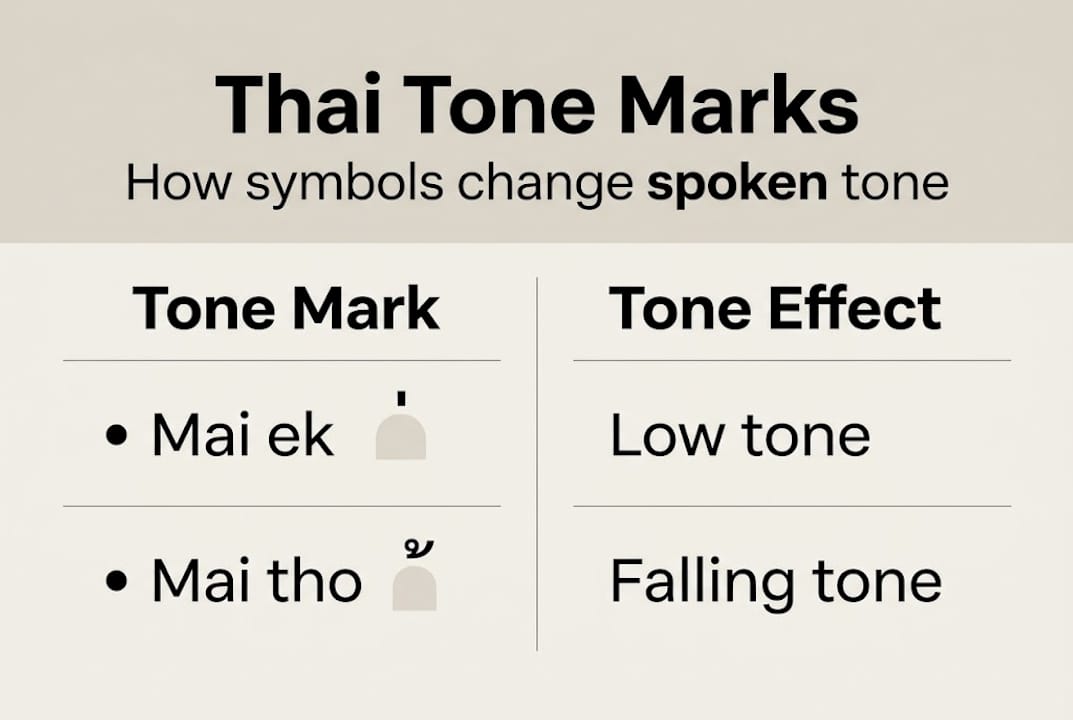
Thai has five tones: mid, low, high, rising, and falling. The tone of any syllable is determined by three factors working together: the consonant class, the syllable type (live or dead), and one of four tone marks explained as mai ek (่), mai tho (้), mai tri (๊), and mai chattawa (๋). Miss one of these, and you have written a different word.
Tone mark overview
| Tone mark | Symbol | Effect on mid-class consonant |
|---|---|---|
| Mai ek | ่ | Low tone |
| Mai tho | ้ | Falling tone |
| Mai tri | ๊ | High tone |
| Mai chattawa | ๋ | Rising tone |
Another feature that surprises new learners: Thai does not use spaces between words. Spaces appear between sentences or clauses, not individual words. Your brain learns to segment meaning from context, which takes practice but becomes natural over time.
Start by learning to recognize and write foundational words. สวัสดี (sawasdee, meaning hello) is a great first target. It uses common consonants and gives you a feel for how characters stack and combine. Explore Thai alphabet basics to build this foundation systematically before moving on to more complex structures.
- Thai consonants each have an associated name and sound
- Vowels appear above, below, before, or after the consonant
- Tone marks sit above the consonant, not the vowel
- Script flows left to right with no capital letters
Gather your tools and resources
Choosing the right tools from the start saves you from frustration later. Thai writing requires both physical and digital practice to build muscle memory and recognition.
For physical practice, use a notebook with grid paper. The grid helps you maintain consistent character size, which matters because Thai letters have specific proportions. Oversized or cramped characters are harder to read and harder to correct. A good mechanical pencil lets you erase and refine strokes without smudging.

For digital practice, apps like Write Me Thai and Thai Script Trainer let you trace characters on a touchscreen, which reinforces stroke order. Anki flashcard decks with Thai script are also widely used for vocabulary building alongside writing.
For structured learning, nothing replaces a real course. NUS CLS offers public Thai courses in part-time evening and online Zoom formats over 10-week terms for adult learners. These provide guided progression through reading and writing together.
Course format comparison
| Format | Best for | Typical duration | Interaction level |
|---|---|---|---|
| Group class (in-person) | Social learners, structured pace | 10 weeks | High |
| Private tutoring | Flexible schedule, fast progress | Ongoing | Very high |
| Online class | Remote learners, busy schedules | 10 weeks | Medium |
| Self-study apps | Supplement to formal learning | Self-paced | Low |
Explore Thai writing courses to find a format that fits your schedule and learning style. If you prefer focused one-on-one attention, private Thai tutoring is one of the fastest ways to build writing accuracy.
Pro Tip: Practice for 15 minutes every day rather than two hours once a week. Short, daily sessions build retention far more effectively than marathon study blocks. Write five new characters each morning and review the previous five before bed.
- Grid notebook and pencil for physical practice
- Tracing apps for digital stroke order reinforcement
- Flashcard apps for vocabulary and script recognition
- A structured course for guided, accountable progression
Step-by-step process to write in Thai
Learning to write Thai works best when you follow a clear sequence. Jumping ahead skips foundational steps that you will need later.
- Learn stroke order for consonants first. Each Thai consonant has a specific stroke sequence. Writing strokes in the correct order makes your characters look natural and helps you write faster as you advance.
- Add vowel placement rules. Vowels attach to consonants in four positions: above, below, before, or after. Practice each position separately before combining them.
- Form your first syllables. Combine a consonant with a single vowel. Start with simple open syllables like กา (kaa) before adding complexity.
- Apply tone mark application rules. Once you can write a syllable, practice adding tone marks. Remember: the mark sits above the consonant, not the vowel symbol.
- Distinguish live from dead syllables. Low-class consonants and dead syllables (those ending in a short vowel or stop consonant) follow different tone rules than live syllables. This distinction is critical for writing words that sound correct.
- Copy common words. Write สวัสดี (hello), ขอบคุณ (thank you), and ใช่ (yes) repeatedly until your hand moves without hesitation.
- Compose original sentences. Use basic Thai sentences as models, then try writing your own using vocabulary you know.
The goal of early writing practice is not speed. It is accuracy. One correctly written syllable teaches you more than ten rushed attempts.
Pro Tip: When you copy a Thai word, say it aloud as you write each character. Connecting the sound to the symbol accelerates both writing and pronunciation at the same time.
Drills matter here. Set a timer for 10 minutes and write a single consonant row repeatedly, then switch to a vowel set. Focused repetition builds the kind of automatic recognition that makes reading and writing feel effortless.
Common mistakes and how to avoid them
Even motivated learners hit the same walls. Knowing what they are ahead of time helps you move past them faster.
Mixing up tone marks and consonant classes is the most frequent error. A learner might write the correct consonant but apply the wrong tone mark, producing a word that sounds completely different. The fix is to always check both the consonant class and the intended tone before placing any mark.
Confusing live and dead syllables trips up writers at the intermediate stage. A dead syllable ends in a short vowel or a stop sound (k, p, t). A live syllable ends in a long vowel or a sonorant. The type of syllable changes which tone rules apply, so misidentifying it leads to wrong pronunciation.
Spacing errors are common because Thai has no word spaces. New writers often add spaces between words out of habit, which looks incorrect in Thai text. Practice reading Thai text without spaces to train your eye to segment naturally.
Strategies that actually work:
- Write with a native teacher who can spot errors you cannot see yourself
- Record yourself reading what you wrote and compare it to a native speaker’s version
- Use Thai tone exercises to isolate tone problems from writing problems
- Review your writing weekly, not just after each session
Learner reviews consistently highlight that structured progression with native teachers accelerates correction and builds real confidence. A patient instructor who speaks both Thai and English can explain exactly why a tone mark placement is wrong, not just that it is.
Pro Tip: Keep an error log. Every time a teacher or app flags a mistake, write it down with the correct version beside it. Review this log before every practice session. You will stop repeating the same errors within weeks.
Read more about learning Thai efficiently to understand how to structure your study time around correction and review.
Check your progress and next steps
Progress in Thai writing is not always obvious from day to day. You need deliberate checkpoints to see how far you have come.
Self-checking is a good starting point. Read your own written Thai aloud without looking at any reference. If you can pronounce what you wrote correctly, your writing is accurate. If you stumble, the error is usually in a tone mark or vowel placement.
Formal evaluation gives you a clearer picture. Take a Thai writing test to benchmark your level against recognized standards. Thai Explorer aligns its curriculum with the CU-TFL (Chulalongkorn University Proficiency Test of Thai as a Foreign Language), so you always know where you stand.
Self-check vs. formal test
| Method | Frequency | Feedback quality | Cost |
|---|---|---|---|
| Read aloud self-check | Daily | Limited | Free |
| Peer review with native speaker | Weekly | Good | Low |
| Formal proficiency test | Every term | Excellent | Moderate |
Once you can write basic sentences accurately, transition to intermediate learning:
- Enroll in a structured intermediate course
- Start writing short journal entries in Thai
- Exchange written messages with a Thai-speaking friend or tutor
- Set a goal to pass the next CU-TFL level within six months
You can continue learning Thai through SkillsFuture-eligible courses at Thai Explorer, which makes advancing more accessible for Singapore residents.
Why slow, structured writing beats shortcuts
Here is something most online guides will not tell you: the learners who try to memorize vocabulary before mastering the script almost always plateau. They can recognize words in context but cannot write them from memory. When the familiar context disappears, so does the ability.
At Thai Explorer, we have watched this pattern repeat. The students who progress furthest are not the fastest starters. They are the ones who spent their first few weeks writing the same 20 consonants until every stroke was automatic. That foundation made everything else faster, not slower.
There is also a confidence effect. When you know you can write correctly, you stop second-guessing yourself mid-sentence. That mental freedom is what allows real communication to happen. Rushing to “useful” content before mastering the script creates a fragile skill that cracks under pressure.
Choose structured Thai courses that sequence content deliberately. Each stage should feel almost too easy before you move to the next. That feeling is not a sign you are going too slow. It is a sign the foundation is solid.
Ready to confidently write in Thai?
If this guide has shown you anything, it is that writing Thai is learnable with the right structure and support. You do not need to figure it out alone.

Thai Explorer offers group classes, private lessons, and online options designed specifically for Singapore learners. Our native Thai instructors are bilingual in Thai and English, so explanations are always clear. Whether you are starting from zero or ready to move past the basics, you can find your Thai course and take the next step today. SkillsFuture credits are accepted, so you can learn Thai in Singapore with financial support. Not sure where to start? Book trial Thai lessons and experience the teaching style before committing.
Frequently asked questions
How many letters are in the Thai alphabet?
The Thai alphabet contains 44 consonants and 32 vowels. Consonants are divided into three tone classes that affect how every syllable sounds.
What are the hardest parts about learning to write Thai?
Most learners struggle with tone marks, syllable types, and script spacing. Dead syllables vs live syllables also create tone rule differences that confuse beginners.
Are there Thai writing classes available for beginners in Singapore?
Yes. NUS CLS offers Thai courses in evening and online formats, and Thai Explorer provides structured beginner to advanced programs with native instructors.
How can I practice Thai writing daily?
Set aside 10 to 15 minutes to copy basic letters, write common words, and check your work against examples or a native tutor’s feedback.
Do I need to learn to speak Thai to write it?
Speaking and writing reinforce each other, but you can begin with script and tone rules first, then layer in pronunciation practice for the best long-term results.