TL;DR:
- Learning a new language in 2026 offers cognitive protection, delays Alzheimer’s onset, and increases earning potential beyond translation apps.
- Practicing with AI tools and live instruction enhances brain function, cultural understanding, and professional trust in a competitive global market.
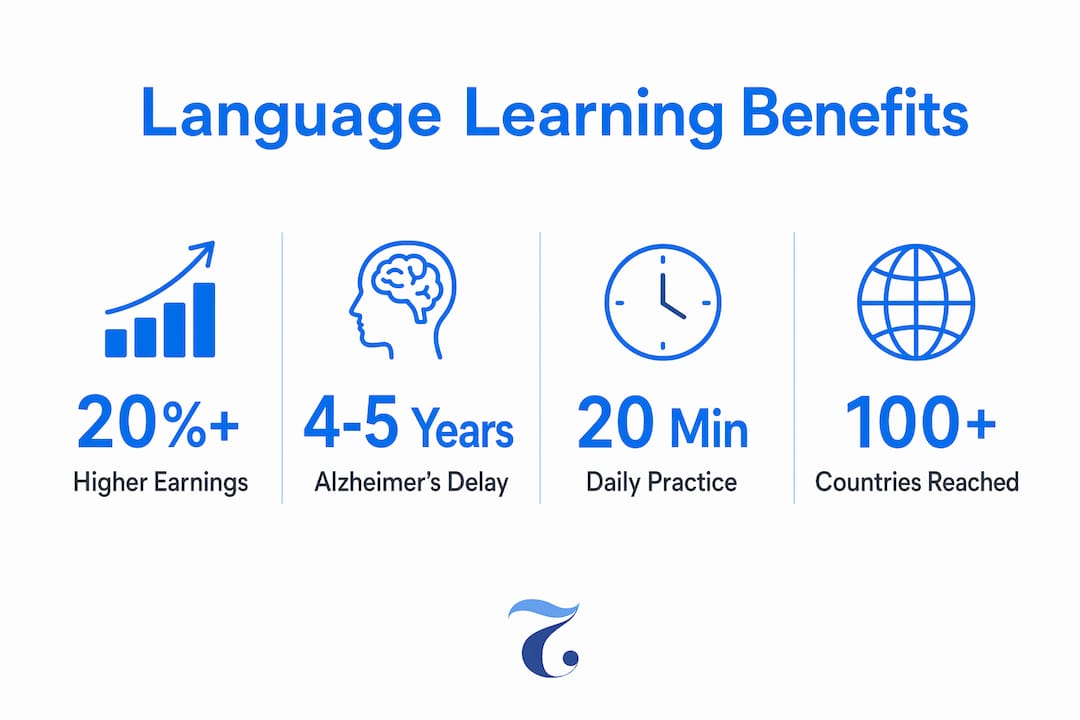
Learning a new language in 2026 delivers measurable advantages in brain health, earning power, and cultural reach that no translation app can replicate. Bilingual employees earn 5% to 20% more per hour than monolingual peers in equivalent roles, and long-term bilingualism delays Alzheimer’s onset by an average of four to five years. With AI tools making practice more personalized than ever and employers placing a premium on cross-cultural communication, the case for why learn a new language in 2026 has never been stronger or better supported by data.
What cognitive benefits come from learning a new language in 2026?
Bilingualism is one of the most well-documented forms of cognitive protection available to adults. Long-term bilingualism delays Alzheimer’s onset by an average of four to five years compared to monolinguals. That gap represents years of independent living, sharper memory, and preserved identity.
The mechanism behind this protection is cognitive reserve. Every time a bilingual speaker selects the right word in one language while suppressing the other, the brain’s executive control networks fire. This constant inhibition and activation of competing languages trains attentional control, task switching, and inhibitory control simultaneously. The brain essentially gets a daily workout that monolinguals do not receive.
The structural benefits go deeper than behavior. Consistent language practice builds neural density and strengthens memory encoding, even before fluency is reached. You do not need to be conversational to start rewiring your brain. The neurological gains begin at the earliest stages of learning.
Key cognitive advantages of bilingualism include:
- Stronger working memory: Managing two language systems increases the brain’s capacity to hold and process information simultaneously.
- Better focus under distraction: Bilingual speakers outperform monolinguals on tasks requiring selective attention in noisy or complex environments.
- Faster mental flexibility: Switching between languages trains the brain to shift between tasks and perspectives with less cognitive friction.
- Delayed cognitive decline: The four-to-five-year delay in Alzheimer’s onset represents one of the most significant non-pharmaceutical interventions documented in aging research.
Pro Tip: You do not need to reach fluency to gain cognitive benefits. Even 20 minutes of daily structured practice builds the neural pathways associated with executive function improvement.
The implication is direct: language learning is not just a communication skill. It is a brain health investment with a return that compounds over decades.
How does learning a language enhance career prospects in 2026?
The economic case for bilingualism is concrete and growing. Bilingual employees earn between 5% and 20% more per hour than monolingual peers in equivalent roles. That premium reflects a supply problem. Most employers want multilingual staff, but relatively few candidates qualify.

The fields where language skills open the most doors include international business development, diplomacy, healthcare, legal services, and tourism. In Southeast Asia specifically, professionals who speak Thai alongside English hold a distinct advantage in sectors like logistics, finance, and hospitality, where Thailand remains a major trade and travel hub. Learning Thai for career growth in this region is a practical move, not an abstract one.
| Career benefit | What it means in practice |
|---|---|
| Higher hourly earnings | 5% to 20% wage premium over monolingual peers in the same role |
| Reduced competition | Fewer qualified bilingual candidates means stronger negotiating position |
| Client trust | Native-language communication builds relationships AI translation cannot replicate |
| Market access | Opens roles in companies operating across language borders |
| Leadership visibility | Multilingual managers are often first considered for international assignments |
Beyond salary, there is a trust factor that no AI tool can fully substitute. When a professional addresses a client or partner in their own language, the relationship shifts. It signals respect, preparation, and genuine investment. That signal accelerates deals, deepens partnerships, and builds loyalty in ways that a translated email simply does not.
AI translation tools like Google Translate and DeepL are fast and useful for basic comprehension. They cannot, however, read the room, adjust register, or pick up on the cultural subtext that shapes whether a business conversation succeeds or stalls.
Why does cultural fluency matter as a reason to learn languages?
Cultural fluency is the ability to understand not just what someone says, but why they say it that way. Language is the primary vehicle for that understanding, and no machine currently delivers it reliably.
MIT researcher Olivia Honeycutt’s work in linguistics and cognition shows that language mastery expands vocabulary for complex emotions and improves self-awareness. When you learn a new language, you gain access to emotional concepts that your first language may not have words for. The Japanese word amae (a comfortable dependence on another’s goodwill) and the Thai concept of kreng jai (reluctance to impose on others) describe social dynamics that English speakers navigate without precise labels. Naming them changes how you perceive and respond to them.
“AI supports language learning as a powerful enabler but cannot replace human cultural insight, social nuance, and trust-building in communication.” — Japan Today analysis on AI vs. human language learning
This matters in travel, networking, and social integration. A traveler who speaks even basic Thai in Bangkok receives a qualitatively different experience than one who relies on a translation app. Locals respond differently. Doors open. Conversations go deeper. The same dynamic applies in professional settings, where cultural empathy determines whether a negotiation feels collaborative or transactional.
Understanding cultural fluency through Thai is not just about politeness. It is about reading situations accurately and responding in ways that build genuine trust.
Pro Tip: When learning a new language, study the culture alongside the grammar. Understanding why a phrase is used matters as much as knowing what it means. Native instructors are the fastest path to this kind of contextual knowledge.
How have 2026’s tech advances changed language learning?
The methods available for language acquisition in 2026 are more effective than at any previous point. Modern language learning now emphasizes practical communication and cultural context over rote memorization, enabled by AI and blended learning models. This shift reflects what employers and learners actually need.
Here is how the best learners are structuring their practice in 2026:
- AI-driven adaptive platforms like Duolingo and Babbel adjust difficulty in real time based on performance, keeping learners in the optimal challenge zone without manual effort.
- Spaced repetition systems built into apps and flashcard tools like Anki use algorithms to schedule review at the exact moment retention starts to fade. Spaced repetition and active recall create measurably better retention than traditional study sessions.
- AI conversation chatbots provide low-stakes speaking practice at any hour, removing the anxiety barrier that stops many adult learners from practicing out loud.
- Live human instruction remains the non-negotiable layer. AI-based exercises improve retention but must be paired with live human feedback to address cultural misunderstandings and sustain motivation.
| Learning method | Strengths | Limitations |
|---|---|---|
| AI adaptive apps | Personalized, always available, tracks progress | Cannot teach cultural nuance or sustain motivation long-term |
| Online live classes | Human feedback, cultural context, real conversation | Requires scheduling and commitment |
| Hybrid blended model | Combines efficiency of AI with depth of human instruction | Requires selecting a quality program |
The most effective approach in 2026 is not AI alone or classroom alone. It is the combination. Understanding how online language learning works helps learners choose the right structure from the start rather than switching methods after losing momentum.
What practical steps help you start learning a language in 2026?
Starting is the hardest part, and the research on adult learners is actually encouraging. Adults’ established vocabulary and metacognitive skills often make their language acquisition more efficient than children’s in grammar and vocabulary. You are not starting from zero. You are building on decades of language pattern recognition.
A February 2026 UK survey found that key motivations to learn languages include personal achievement (40%), brain health (26%), and cultural connection (25%). Knowing your own motivation matters because it determines which learning format will hold your attention long enough to produce results.
Practical steps that work for adult learners:
- Set a specific goal, not a vague one. “I want to hold a five-minute conversation about my work in Thai by month three” is a goal. “I want to learn Thai” is not.
- Build a daily habit of 20 to 30 minutes rather than long weekend sessions. Consistency beats intensity in language acquisition.
- Use Duolingo or a similar app for daily vocabulary reinforcement, but treat it as a supplement to structured instruction, not a replacement.
- Enroll in a structured course with a qualified instructor early. Self-study builds habits; a teacher builds accuracy and corrects errors before they fossilize.
- Speak from week one. Waiting until you feel ready delays the most important skill. Mistakes in a safe learning environment accelerate progress faster than perfect silent study.
Pro Tip: Pair every AI practice session with at least one live conversation per week, whether with a teacher, a language partner, or a native speaker. The discomfort of real conversation is where the real learning happens.
Key takeaways
Learning a new language in 2026 delivers cognitive protection, a measurable salary premium, and cultural access that AI translation tools cannot replicate, making it one of the highest-return personal investments available to adults.
| Point | Details |
|---|---|
| Cognitive protection | Bilingualism delays Alzheimer’s onset by 4 to 5 years and builds executive function from the earliest stages of learning. |
| Career earnings premium | Bilingual employees earn 5% to 20% more per hour than monolingual peers in equivalent roles. |
| Cultural fluency advantage | Language learning expands emotional vocabulary and builds social trust that AI translation cannot deliver. |
| Technology as a tool, not a replacement | AI apps and spaced repetition improve retention but must be paired with live human instruction for lasting results. |
| Adults learn efficiently | Established metacognitive skills make adult learners faster at grammar and vocabulary acquisition than is commonly assumed. |
Why I think the “AI will replace language learning” argument misses the point
I have heard the argument dozens of times: why spend months learning a language when Google Translate exists? It sounds logical until you watch it fail in a real conversation.
The argument treats language as a code-switching problem. Input Thai, output English. But language is not a code. It is a social contract. When you speak to someone in their language, you are signaling that you took the time to understand their world. That signal cannot be faked by an app, and it changes the entire dynamic of the interaction.
What I find most underappreciated in the benefits of learning languages in 2026 is the emotional intelligence gain. MIT’s research on how language shapes thought is not abstract. When you learn Thai, you internalize a different framework for social hierarchy, politeness, and relational obligation. That framework makes you a better communicator in English too, because you start noticing dynamics you previously could not name.
The people I have seen benefit most from language learning are not the ones who became perfectly fluent. They are the ones who committed long enough to start thinking differently. That shift in perspective is the real return on investment, and no AI delivers it.
The role of native Thai teachers in this process is irreplaceable. Cultural nuance, tonal accuracy, and the kind of real-time correction that prevents bad habits from setting in require a human who has lived the language, not just processed it.
— Paul
Start learning Thai with Thai Explorer in Singapore
Thai Explorer offers structured adult Thai language courses designed for conversational fluency and business communication, with flexible options that fit around professional schedules. Classes run online via Zoom and in-person at the training center at 10 Anson Road, #22-07, International Plaza, Singapore 079903, located directly above Tanjong Pagar MRT.
Whether you are preparing for business travel to Thailand, building professional relationships across Southeast Asia, or simply investing in a skill with proven cognitive and career returns, Thai Explorer’s qualified native instructors deliver the cultural depth and structured feedback that apps alone cannot provide. Group, private, and corporate training formats are all available.
Explore the full range of adult Thai courses and find the format that fits your goals. For a deeper look at what the curriculum covers, the Thai language learning program page outlines speaking, listening, reading, and writing tracks aligned with recognized proficiency standards.
FAQ
Why learn a new language in 2026 when AI can translate?
AI translation handles basic text but cannot build social trust, read cultural context, or develop the cognitive benefits that come from actual language acquisition. Language learning remains a distinct skill with measurable brain health and career returns.
How much more can bilingual professionals earn?
Bilingual employees in the U.S. earn between 5% and 20% more per hour than monolingual peers in equivalent roles, according to NYU research. The premium reflects genuine scarcity of language-qualified candidates in most industries.
Is it harder to learn a language as an adult?
Adults are actually more efficient than children at grammar and vocabulary acquisition because of established metacognitive skills and prior language pattern recognition. Consistency and structured instruction matter more than age.
How long does it take to reach conversational fluency?
Timeline depends on the language, daily practice time, and instruction quality. With 20 to 30 minutes of daily structured practice combined with live instruction, most adult learners reach basic conversational ability in three to six months.
What is the best way to start learning Thai in Singapore?
Enrolling in a structured course with a qualified native instructor is the fastest path to accurate pronunciation and cultural understanding. Pairing live classes with AI-assisted daily practice produces the best results for adult learners.