
CU-TFL is a Thai proficiency test for non-native speakers from the Sirindhorn Thai Language Institute at Chulalongkorn University. It assesses listening, reading, writing and speaking. Before choosing a test, confirm which result your university or employer accepts.
- Who issues it: The Sirindhorn Thai Language Institute, Chulalongkorn University, Bangkok
- What it assesses: Four language skills; see the university’s March 2025 summary and confirm your round’s reporting.
- Modular option: You can sit all four skills together or take individual sections separately
- Score validity: Confirm the accepted validity period with your receiving institution or employer before registering
- Where to register: Directly through the Sirindhorn Thai Language Institute’s official site; check for upcoming test rounds
Table of Contents
- What is CU-TFL certification and who actually needs it?
- How is the CU-TFL exam structured?
- How does CU-TFL scoring work, and what do the bands mean?
- How to register, what it costs, and where you can sit the test
- How to prepare for CU-TFL: a practical study plan
- How Thai Explorer’s courses align with CU-TFL
- Your next steps before the test date
- Key Takeaways
- Why standardized testing matters more than most learners realize
- Thai Explorer’s CU-TFL preparation courses
- Useful sources
- FAQ
What is CU-TFL certification and who actually needs it?
CU-TFL is designed for non-native Thai speakers. The university’s March 2025 introduction describes the test. Use current provider instructions when booking.
Reasons to check whether the test fits your needs:
- International students applying to Thai universities that require a formal language benchmark
- Professionals whose employer requests a documented Thai proficiency result; confirm the accepted test and required skills first.
- Self-directed learners who want an objective measure of where they actually stand
CU-TFL is issued by the university’s Sirindhorn Thai Language Institute. A language-school course and independent university testing are separate services; completing a course does not itself confer this credential.
Before choosing a test: Ask the receiving organisation for its accepted tests, skills, result levels and report-age requirements.
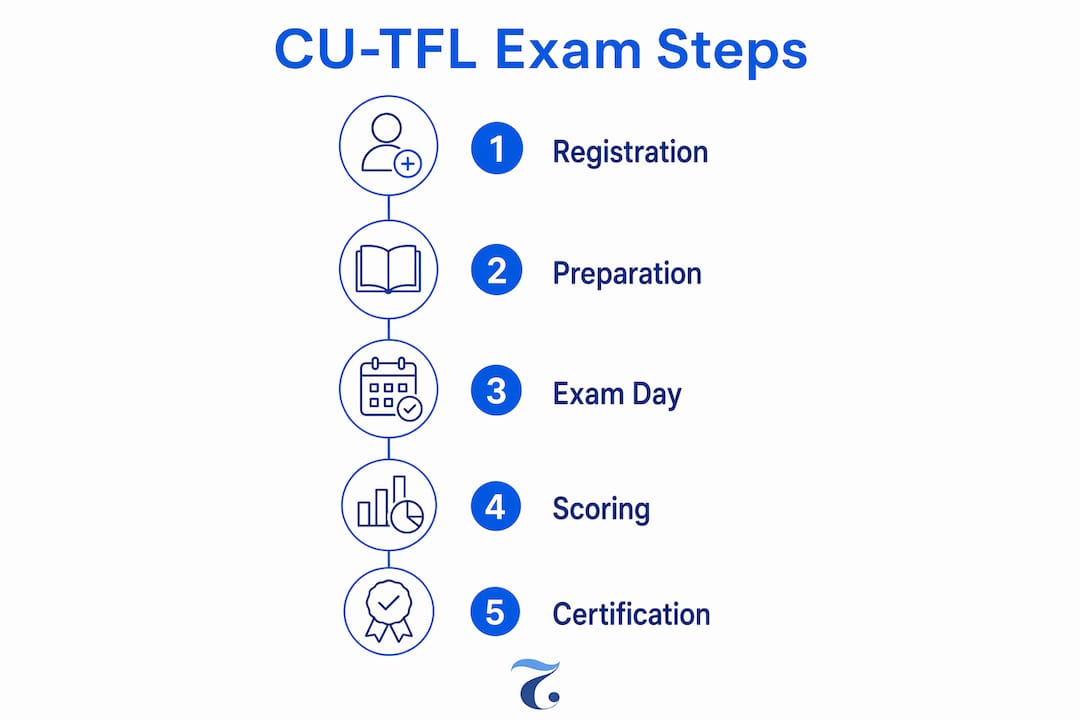
For a broader look at how CU-TFL fits among other recognized Thai language tests, it helps to compare the options before committing to a test date.
How is the CU-TFL exam structured?
The university’s 2025 introduction describes four skills and individual-skill options. The table summarises the reported timing; confirm the format of your booked round.

| Section | Typical Duration | Reported Level | Preparation focus |
|---|---|---|---|
| Listening | ~60 min in the university’s 2025 description | Proficiency level | Listen to a short recording and summarise its meaning. |
| Reading | ~60 min in the university’s 2025 description | Proficiency level | Read a passage and check your understanding. |
| Writing | ~60 min | Proficiency level | Practise organising a written response in Thai. |
| Speaking | ~45 min | Proficiency level | Practise responding to spoken questions. |
The table reflects a dated university description, not a guarantee of the next test round’s timing or task format.
Practice suggestions, rather than confirmed current exam tasks:
- Use different recordings to practise understanding spoken Thai.
- Practise reading everyday and more formal texts.
- Practise written responses and ask for feedback on clarity and Thai script.
- Practise answering unfamiliar questions without reading a prepared script.
Planning separate skills: Ask whether your receiving organisation accepts separate results and which current options the test provider offers.
How does CU-TFL scoring work, and what do the bands mean?
The university’s March 2025 description lists five proficiency levels. Confirm current reporting for your booked round:
- Chula Distinguished
- Chula Superior
- Chula Advanced
- Chula Intermediate
- Chula Novice
Check the provider’s current descriptors when interpreting a result. Do not assume a school course level converts automatically into a CU-TFL result.
Confirm report-age requirements with the receiving institution or employer before paying for a test.
Ask the receiving institution or employer which skills, result levels and report dates it requires. Do not assume that one organisation’s threshold applies to another.
Use the official result report and the receiving organisation’s requirements when deciding your next study steps.
How to register, what it costs, and where you can sit the test
Before booking through the Sirindhorn Thai Language Institute, confirm the current registration instructions and the following details:
- Check the current test calendar on the institute’s site for available rounds and locations
- Confirm which registration form and identity documents the provider requires.
- Select the skill(s) you want to sit and confirm your preferred test center
- Confirm the total fee, payment currency, method and deadline for the skills and location you choose.
- Check admission instructions and which identification to bring on test day.
Exam fees are separate from Thai Explorer’s course fees. Ask the test provider for the current charge for each selected skill and location before paying.
Test locations and availability:
- Location: Confirm the venue for your selected round with the test provider.
- Ask which university or test centre hosts the round you intend to book.
- The university’s 2025 article mentions testing in Taiwan, China and Japan. Check current round availability.
For learners based in Singapore, confirm the available location and any travel requirements with the test provider before making arrangements. Do not assume that a local language course is also an exam venue or booking service.
Logistics questions to confirm before booking:
- Ask for the arrival time, late-arrival policy and identification requirements.
- Confirm cancellation, refund and rescheduling conditions before paying.
- Check the spelling of your registration details and ask how corrections are handled.
How to prepare for CU-TFL: a practical study plan
Preparation works best when you treat each skill as its own project, then integrate them in the final weeks.
Skill-by-skill priorities:
- Listening: Daily exposure to Thai audio at natural speed, dictation exercises, and comprehension drills using news broadcasts or podcasts
- Reading: Timed reading practice with Thai-script texts, vocabulary frequency lists, and passage-level comprehension questions
- Writing: Structured essay practice with feedback, grammar drills focused on formal register, and Thai script accuracy work
- Speaking: Recorded self-practice, mock interviews with a native speaker or tutor, and work on spontaneous response speed
Illustrative preparation schedule: adapt the tasks and time to your current level and booked test date.
- Weeks 1–2: Thai script review and phonology; build vocabulary from frequency lists
- Weeks 3–4: Listening comprehension drills; timed reading passages at Intermediate level
- Weeks 5–6: Writing structure practice; formal essay drafts with instructor feedback
- Weeks 7–8: Speaking mock interviews; integrated listening and reading under timed conditions
- Weeks 9–10: Timed practice, review of difficult tasks and a final vocabulary check.
Use any current sample material the test provider publishes to check the task format. Confirm that it applies to the round you intend to book.
Individual skills were available in the university’s 2025 description. Confirm current booking and result-combination rules before planning separate sittings.
For a structured approach to study planning, Thai Explorer’s study tips for Thai certification offer a practical framework that maps directly to CU-TFL preparation.

How Thai Explorer’s courses align with CU-TFL
CU-TFL tests listening, reading, writing and speaking. Thai Explorer describes its curriculum as CU-TFL-aligned. Ask how your chosen course addresses the skills you need and what practice, feedback or mock tests are included.
Use these practice areas as questions when comparing preparation options:
- Thai script, tones and pronunciation practice
- Listening comprehension and note-taking
- Reading and passage comprehension
- Writing organisation and appropriate register
- Spontaneous speaking and interview practice
- Timed practice and feedback on difficult tasks
Instructors at Thai Explorer are bilingual native Thai speakers, which matters for the speaking section in particular. Feedback on pronunciation, register, and spontaneous response is more precise when your tutor can explain the difference between how something sounds to a native ear versus how a textbook describes it.
Timed practice can help you check how you organise an answer under a time limit. Ask what practice and feedback your course includes rather than assuming a particular number of mock tests is built into every format.
For more on how course design connects to CU-TFL outcomes, the course alignment guide for educators explains the methodology in detail.
Your next steps before the test date
If you are ready to move from planning to action, work through this checklist:
- Visit the Sirindhorn Thai Language Institute’s official site and check the current test calendar
- Confirm your ID documents are valid and match the name you will use for registration
- Choose a test date after considering your current level, target skills and preparation needs.
- Allow time to practise the task format and review feedback before your test date.
- Enroll in a targeted course if you need structured instruction, especially for writing and speaking
A few additional notes for international candidates:
- Ask which overseas rounds are currently available and how registration works for your chosen location.
- If you are based in Singapore, confirm where you will sit the test and any travel arrangements before paying.
- Preparation needs vary. Compare your present skills with the tasks and result requirements rather than assuming an 8–12-week course establishes readiness.
Key Takeaways
CU-TFL is one way to document Thai proficiency. Before registering, ask the receiving university or employer which test, skills, result levels and report dates it accepts.
| Point | Details |
|---|---|
| Issuer and authority | The Sirindhorn Thai Language Institute at Chulalongkorn University designs and administers CU-TFL. |
| Four-skill structure | Skills can be taken individually; confirm current registration requirements. |
| Score validity | Confirm the accepted validity period with your receiving institution or employer before registering. |
| International availability | The university’s March 2025 introduction mentioned Taiwan, China and Japan. Confirm current venues and round availability with the provider. |
| Thai Explorer preparation | Ask how the chosen course covers the exam skills you need and what feedback or mock-test practice is available. |
Why standardized testing matters more than most learners realize
Most people who study Thai seriously hit a point where they genuinely cannot tell how good they are. They can hold a conversation, they can read a menu, maybe they can write a short message. But “pretty good” is not a number, and it does not appear on a university application or a resume.
A result can help you discuss further study, but its use depends on the receiving organisation’s requirements. Review the reported skill results and ask which practice would address your needs.
Use practice tasks and feedback to choose what to study next. Neither following a checklist nor completing a fixed number of study weeks guarantees a test result.
Thai Explorer’s CU-TFL preparation courses
If you want help preparing, compare the instruction, feedback and practice offered by the available course formats with the skills you need.
Thai Explorer offers adult group, private and live online Thai lessons with native Thai teachers. If you are preparing for CU-TFL, ask which current course format fits the skills you need and what test practice is included. School tuition and independent exam registration are separate decisions.
Browse the current Thai course options and separate placement-test route. Ask about exam-related practice before booking; the placement test is not the university examination.
Useful sources
- Sirindhorn Thai Language Institute: CU-TFL — consult the provider for current registration and test details.
- Confirm current logistics, admission requirements and payment conditions with the provider.
- Chulalongkorn University’s March 2025 introduction — dated background on skills, reported levels and overseas testing.
- Ask the provider which current candidate guidance applies to your booked round.
- Ask the receiving organisation which test results it accepts.
Always confirm current test dates, fees, and registration deadlines directly with the Sirindhorn Thai Language Institute, as these details change between test rounds.
FAQ
What is CU-TFL?
CU-TFL assesses listening, reading, writing and speaking. The university’s 2025 description lists proficiency levels from Novice through Distinguished. Confirm current reporting for your round.
How long are CU-TFL scores valid?
Confirm report-age requirements with the receiving institution or employer. A completed test does not guarantee that every organisation accepts the same report indefinitely.
Can I take just one section of the CU-TFL instead of all four?
The university’s 2025 description allows individual-skill tests. Ask about current result-reporting rules and the receiving organisation’s requirements.
How is the CU-TFL speaking section conducted?
The university’s 2025 description gives approximately 45 minutes for speaking with assessors. Confirm current booking details.
What is the difference between CU-TFL and CU-TEP?
CU-TEP is Chulalongkorn University’s English proficiency test; CU-TFL is its Thai proficiency equivalent for non-native speakers. Both are issued by Chulalongkorn University but test entirely different languages and serve different applicant groups.