
Teach tones and listening first, introduce the script within the first few weeks, then move into functional vocabulary and sentence frames with immediate speaking practice. This sequence works because it fixes pronunciation before habits calcify, and it applies equally to a group classroom, a private lesson, or a Zoom session. Small, frequent speaking drills with native correction matter more than any textbook chapter.
TL;DR:
- Teaching tone and listening skills first significantly reduces pronunciation errors, especially in the initial weeks before introducing script or vocabulary.
- Short, frequent drills focused on tone pairs and immediate native correction are more effective than lengthy or infrequent sessions for building accurate pronunciation.
- Structured 4- to 8-week courses that layer speaking, reading, and conversational practice in stages produce measurable improvements in fluency.
- Prioritizing active output activities like role plays and micro-tasks accelerates speaking proficiency more than passive listening alone.
- Correcting tonal errors immediately, rather than alongside grammar mistakes, enhances retention and prevents ingrained mispronunciations.
Table of Contents
- How to Teach Thai in Stages: A Framework That Works
- What Core Skills Should You Teach First, and How?
- Sample Lesson Plans for Group, Private, and Online Classes
- Which Activities Build Speaking Skill Fastest?
- How Do You Measure a Student’s Progress?
- Why Thai Explorer’s Classroom Practices Back This Approach
- An Instructor’s Note on What Actually Moves the Needle
- Ready to Put This Framework Into Practice?
- Sources
- FAQ
How to Teach Thai in Stages: A Framework That Works
Most Thai teaching mistakes trace back to sequencing, not effort. Teachers who dump vocabulary lists on day one create students who mispronounce the same fifty words for months, because nobody corrected the tone the first time it mattered. Training the ear before training the tongue reduces that rework, and teachers who prioritize tone and listening before large vocabulary sets see fewer entrenched pronunciation errors later on.
The staged approach breaks down into four phases:
- Tone and listening foundation (weeks 1 to 2). Learners hear the five tones repeatedly before producing them. No script yet, just ear training and imitation.
- Script introduction (weeks 2 to 4). Reading begins early because Thai orthography encodes tone rules directly, so reading reinforces what the ear already caught.
- Functional vocabulary and sentence frames (weeks 3 to 6). Instead of isolated words, teach templates learners can swap words into immediately.
- Guided conversation with feedback (week 4 onward). Real exchanges, corrected in real time, replacing drills with dialogue.
A 4-week beginner plan compresses this into daily 45 to 60 minute sessions: tones and 20 survival phrases in week one, script basics and greetings in week two, question forms and shopping/ordering language in week three, and free conversation practice in week four. An 8-week version slows the pace, adds a second script-reading block, and layers in role plays by week six. Structured 8-week programs that keep daily practice at 45 to 60 minutes produce measurable speaking gains precisely because the blocks stay short and consistent rather than sprawling into occasional marathon sessions.
What Core Skills Should You Teach First, and How?
Five skills make or break a Thai learner’s early progress: tones, pronunciation, script, vocabulary, and politeness register. Each needs a different teaching method, not a shared one.
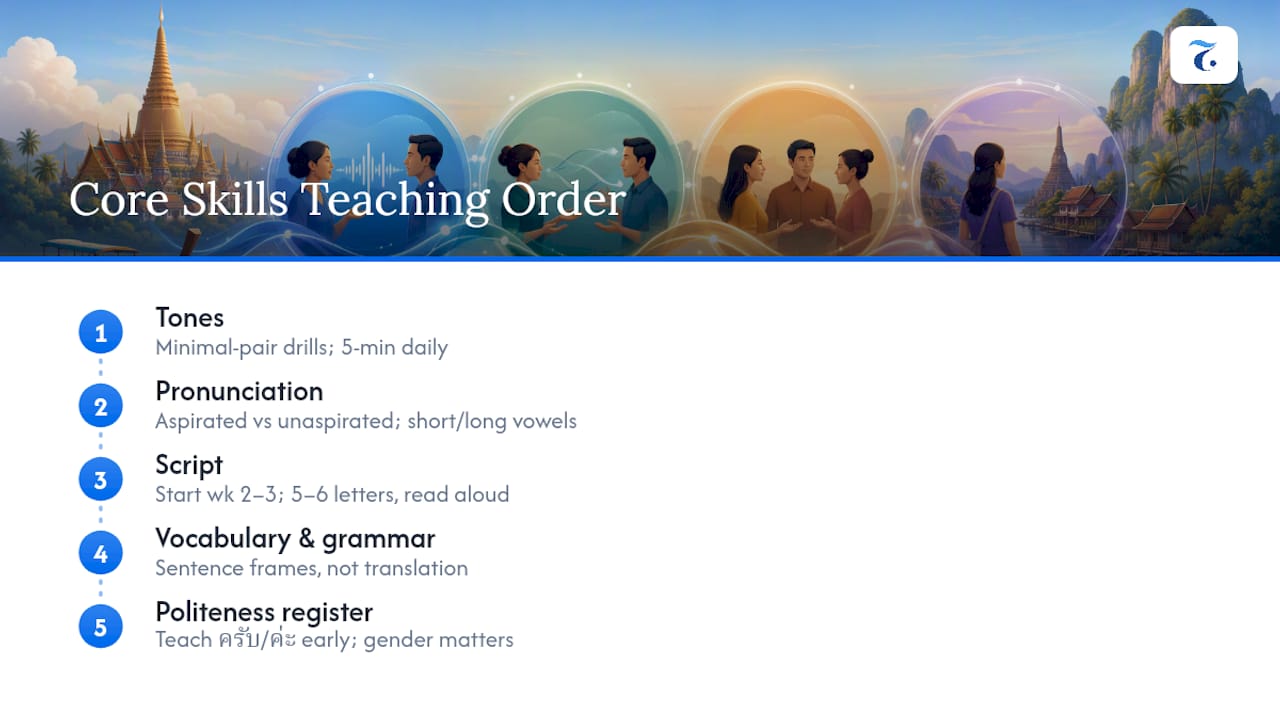
Tones respond best to minimal-pair drills. Present two words that differ only in tone, have the student repeat both, then record and compare against a native speaker’s version. Do this daily in short five-minute bursts rather than one long weekly session. Our Thai tone exercises give five ready-made drills you can assign directly.
Pronunciation priorities beyond tone: unaspirated versus aspirated stops (the difference between ป and พ trips up almost every English speaker), and vowel length, since a short and long vowel can change a word’s meaning entirely. An IPA reference chart helps learners see exactly where their mouth should land.

Script should start once basic tones are stable, usually week two or three. Teach small letter sets, five or six characters at a time, and pair every new letter with a reading-aloud task so students hear tone rules as they decode.
Vocabulary and grammar work best as sentence frames, not translation drills. Teaching principles rather than direct translation lets students build new sentences instead of memorizing fixed phrases. Our beginner grammar guide shows this frame-based approach in practice.
Politeness particles like ครับ and ค่ะ change with gender and context, and skipping them early creates habits that sound abrupt later.
Pro Tip: Record every drill session. Students rarely notice their own tone mistakes in the moment, but they hear them instantly on playback next to a native model.
Sample Lesson Plans for Group, Private, and Online Classes
A single lesson template adapts across every format if you keep the time blocks flexible. Here is the reproducible structure:
- Warm-up and tone review (short time)
- Drilling new sounds or vocabulary (brief focus)
- Controlled practice, worksheets or paired repetition (moderate duration)
- Communicative task, a role play or information gap (moderate duration)
- Feedback and correction recap (short time)
For group classes, the communicative task becomes pairwork, and the teacher circulates rather than lectures. For private lessons, you can compress the drilling phase and extend the conversation block since there’s no group pacing to manage. For online sessions, a few adjustments matter:
- Use breakout rooms for pairwork so students speak more, not less, on Zoom.
- Record the session audio so learners can replay their own pronunciation attempts.
- Screen-share the script during reading practice so everyone tracks the same line.
Maximizing feedback in a group setting means calling on students in a fixed rotation rather than waiting for volunteers, since volunteers are almost always the same two confident speakers. Our guide on teaching Thai to English speakers covers format-specific pacing in more detail.
Which Activities Build Speaking Skill Fastest?
Passive listening builds recognition; production builds fluency. The activities that close that gap fastest share one trait: they force output within seconds, not minutes.
- Two-line dialogues. Give students a fixed exchange, have them swap roles, then swap one variable (a name, a food item, a number) and repeat.
- Micro-tasks. Sixty-second challenges like “order three things from this menu” force quick, functional output without overthinking grammar.
- Timed fluency drills. Give a topic and 30 seconds to speak nonstop, errors included. Fluency practice like this trains automaticity, not accuracy.
- Role-play scripts. Market haggling, taxi directions, and hotel check-in cover the situations most adult learners actually need.
When correcting, fix tonal errors before grammar errors. A wrong tone can change a word’s meaning entirely, while a missing particle rarely does. Peer correction works too, but set a rule: students flag a mispronounced tone immediately, and save grammar notes for the feedback recap at the end.
Pro Tip: Assign a language-exchange app for homework between sessions. Community voice feedback from native speakers multiplies correction opportunities beyond what one weekly lesson can offer.
How Do You Measure a Student’s Progress?
Set checkpoints early so progress is visible, not assumed. At 2 weeks, a student should introduce themselves and order a drink correctly, tones included. At 8 weeks, they should handle a simple transaction, directions, or small talk unscripted. At 24 weeks, a short unscripted conversation on a familiar topic becomes the benchmark.
Formative checks that take five minutes each:
- A 1-minute recorded speaking sample, reviewed for tone accuracy
- Reading a short passage aloud to check script fluency
- Answering three comprehension prompts from a listening clip
For programs planning longer curriculum arcs, CU-TFL gives a recognized proficiency framework worth referencing when setting multi-month goals, particularly for learners aiming at professional-level fluency rather than travel basics.
Why Thai Explorer’s Classroom Practices Back This Approach
This sequence is not theoretical. Thai Explorer’s native, bilingual instructors build every course around tone-first listening work, early script introduction, and CU-TFL-aligned progression, so classroom outcomes map to a recognized standard rather than guesswork. Lessons pair pronunciation drills with cultural context, since knowing when to use ครับ at a market versus in a business meeting matters as much as grammar accuracy.
Courses run in group, private, and online Zoom formats, so the same staged framework works whether a learner needs corporate-ready Thai or conversational skill for travel. Classes meet at 10 Anson Road, #22-07, International Plaza, Singapore 079903, directly above Tanjong Pagar MRT, making in-person sessions easy to reach for working professionals.
An Instructor’s Note on What Actually Moves the Needle
The habit most teachers skip is deliberately silent listening time before any speaking is asked of the student. Give a learner two full minutes of just hearing a tone pair repeated, no pressure to respond, before asking them to produce it. Rushing straight to production is why so many adult learners freeze mid-sentence. Their ear never had time to calibrate.
One instruction I give every new teacher I train: never correct a tone error and a grammar error in the same breath. Pick one, fix it, move on. Stacking corrections overwhelms the learner and they retain neither fix. Isolate the correction, repeat the target word three times, then continue the conversation. It feels slower in the moment. It is not, once you count how many fewer repetitions the student needs weeks later.
— Paul
Ready to Put This Framework Into Practice?
Reading about a tones-first sequence is one thing; running it in a live classroom with real-time correction is another. Thai Explorer built its courses around exactly this approach, with native bilingual instructors who drill tones before vocabulary and give the kind of immediate feedback a self-study app simply cannot replicate.

Whether you learn better in a group setting, want the pace and attention of private lessons, or need the flexibility of Zoom sessions around a work schedule, the Thai course options are structured around the staged framework covered above. Corporate teams looking for structured business Thai can find the right fit through the same group class options, and online learners can start immediately through the Zoom-based course. Classes are held at 10 Anson Road, #22-07, International Plaza, Singapore 079903, right above Tanjong Pagar MRT. Book a trial session to see the tone-first method in action before committing to a full course.
Sources
FAQ
How do you say “I love you” in Thai?
“I love you” in Thai is ผมรักคุณ (phǒm rák khun) when a man speaks, or ฉันรักคุณ (chǎn rák khun) when a woman speaks, with รัก (rák) carrying a mid tone that needs to stay flat and even.
How do you say “hi” in Thai?
The standard greeting is สวัสดี (sà wàt dii), used for both “hi” and “goodbye,” and adding ครับ (khráp) for men or ค่ะ (khâ) for women makes it politely appropriate in almost any setting.
Can I learn Thai in 2 months?
A focused 8-week plan with daily 45 to 60 minute practice and consistent native feedback can get a learner to basic conversational ability, though fluency for complex topics takes considerably longer.
How easy is Thai to learn?
Thai’s tone system and unfamiliar script make it harder than many European languages at the start, but a structured approach combining listening, speaking, and progressive reading makes steady progress realistic within a few months of consistent practice.