
The single best way to learn Thai as an adult is to train your ear to the five tones first, start speaking short phrase frames within the first two weeks, and introduce the script only after your ear can reliably distinguish tone classes. Thirty minutes of focused daily practice beats two-hour weekend cramming sessions every time. The US Foreign Service Institute classifies Thai as a Category IV language, meaning it typically takes significantly more study hours than European languages for English speakers — so your sequencing and consistency matter more than raw time spent.
Start today with these five actions:
- Listen to a five-tone audio drill (YouTube has dozens).
- Mimic each tone five times out loud.
- Learn two greeting phrases: Sawasdee krap (male) / Sawasdee ka (female) and practice saying them with the correct falling tone on dee.
- Schedule a 15-minute session on HelloTalk or italki for this week — even a single exchange session builds speaking habits early.
- Add five high-frequency words to an Anki deck, each tagged with its tone class.
- Write down your weekly study goal: survival phrases in 4–6 weeks at 30 minutes/day, or basic conversation in 4–6 months with consistent speaking practice.
Thai Explorer, a structured Thai language school, reports that learners who combine tone training with early speaking practice reach survival-level confidence noticeably faster than those who spend the first month on vocabulary lists alone.
Table of Contents
- What is the best way to learn Thai as a beginner?
- Do you actually need to learn the Thai script?
- What are the best resources for learning Thai?
- How do you get real speaking practice in Thai?
- How long does it take to learn Thai?
- A sample 8-week study plan you can start today
- Why a structured course accelerates your progress
- Key Takeaways
- The technique most learners overlook
- Thai Explorer offers structured Thai courses for adults
- Useful sources
- FAQ
What is the best way to learn Thai as a beginner?
The answer is sequencing. Most learners who struggle with Thai did not fail because the language is impossibly hard. They failed because they learned vocabulary before their ears could hear the tones, then had to relearn hundreds of words. Tone-first sequencing — tones, then script, then vocabulary, then conversation — prevents that rework and speeds reliable pronunciation from the start.
Here is a practical 12-week roadmap built around that sequence.
Weeks 5–8: Core vocabulary and simple reading
Now vocabulary sticks faster because your ear already knows where each word sits tonally. Add 10–15 new words per day in Anki, always with audio. Start reading short Thai captions or menus alongside your spoken practice.
Weeks 9–12: Guided conversation
Move the majority of your practice time into real conversation: tutor sessions, language exchange, or structured roleplay. Grammar in Thai is less inflected than most European languages, so speaking-first approaches help most learners reach usable conversation faster than grammar-heavy study.
- Benchmark by Week 12: You can handle basic transactional conversations (ordering food, asking directions, simple small talk) and read short sentences with some assistance.
Flexibility note: If you have only 20 minutes a day, compress each phase by one week and prioritize speaking over reading. If you have 60+ minutes, add a second daily review pass on your Anki deck and one extra tutor session per week.
Do you actually need to learn the Thai script?
Short answer: not immediately, but eventually yes. You can start speaking Thai without reading a single character. The script becomes genuinely useful once your tones are stable, because Thai’s consonant classes are essentially a built-in tone guide. Learning them at that point reinforces what your ear already knows rather than adding a new cognitive load on top of an unfamiliar sound system.
Pros of learning the script:
- Long-term reading and writing independence (menus, signs, messages)
- Consonant classes clarify tone rules you are already learning aurally
- Reduces dependence on romanization, which is inconsistent across sources
Cons of starting the script too early:
- Romanization becomes a crutch that slows tone internalization
- Beginners often focus on decoding letters instead of listening to pitch
- Script study can crowd out speaking time in the critical first weeks
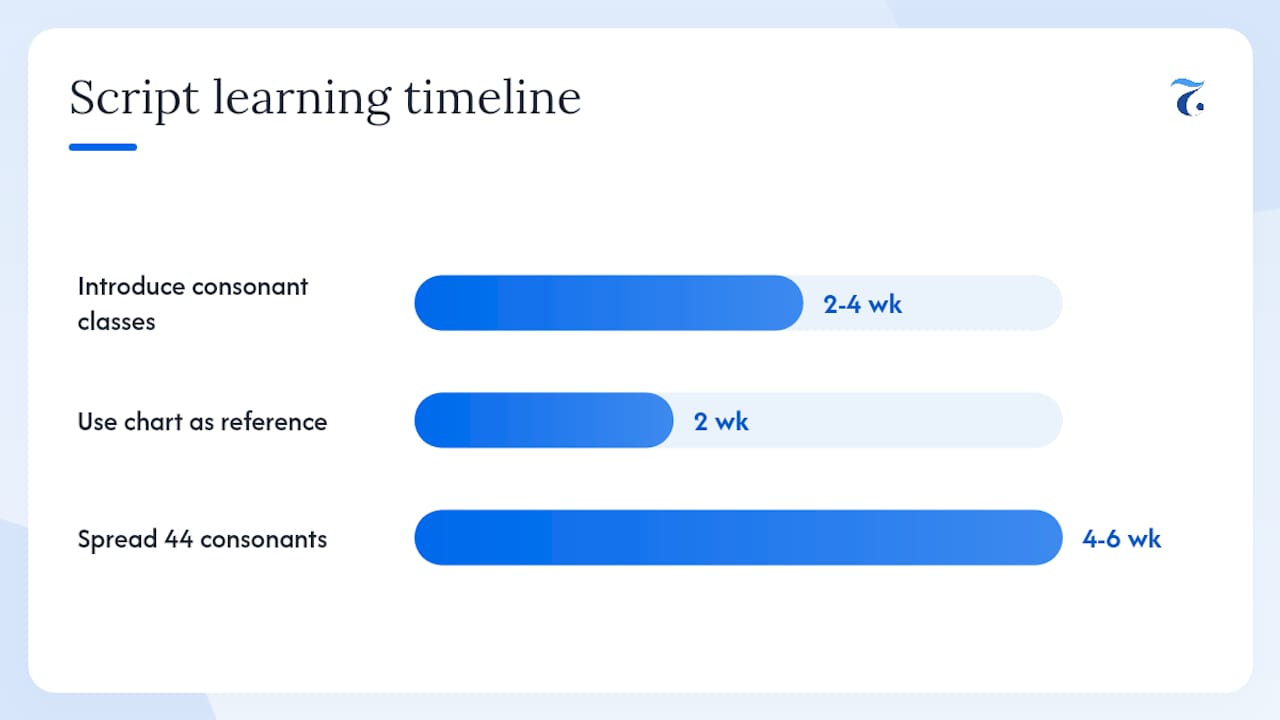
Recommended timeline: Introduce consonant classes in Weeks 2–4, after you can distinguish all five tones by ear. Tie each new script character to a spoken word you already know. Avoid romanization as your primary reference after Week 4.
Low-effort ways to start script learning without derailing speaking:
- Flashcard one consonant class per day (there are three classes, 44 consonants total — spread it over 4–6 weeks)
- Write the Thai spelling of every new Anki word alongside its romanization
- Read Thai subtitles on a Thai TV clip for 5 minutes after your speaking session
- Use a consonant-class chart as a reference, not a memorization target, for the first two weeks
What are the best resources for learning Thai?
Apps, tutors, SRS tools, and podcasts each train a different skill. The mistake most learners make is picking one and expecting it to do everything. Real-life phrase practice and structural understanding consistently outperform app-only study for early conversational gains. Here is how each major tool fits into a complete routine, and what it cannot do alone.
| Tool | Best for | Primary skill | Typical cost | Daily minutes | Time to conversational results |
|---|---|---|---|---|---|
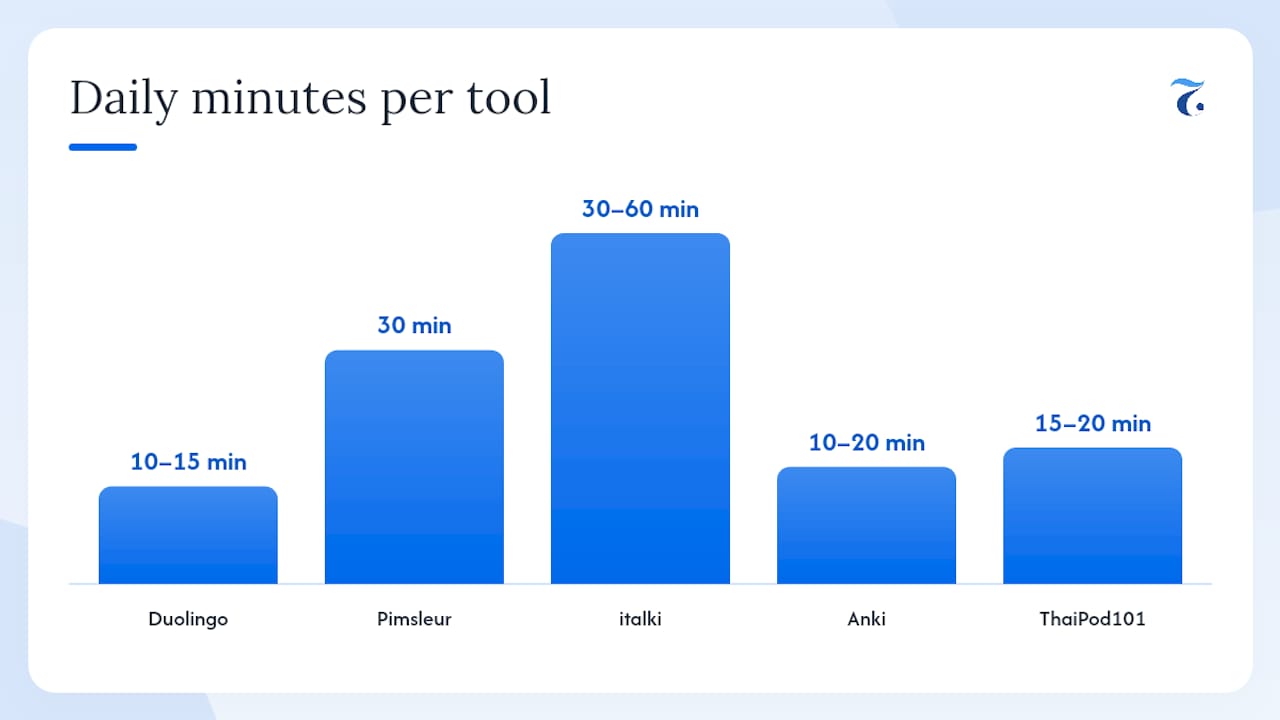
| Duolingo | Absolute beginners, vocabulary exposure | Reading/vocab | Free | 10–15 | Slow alone; useful to A2 |
| Pimsleur | Spoken phrase drilling, commuters | Speaking/listening | ~$20/mo | 30 | 2–3 months for survival phrases |
| italki | Real conversation, tone correction | Speaking | $10/hr | 30–60 | Fastest route to fluency |
| Anki | Vocabulary retention, tone-tagged cards | Vocabulary | Free | 10–20 | Ongoing; compounds over months |
| ThaiPod101 | Structured listening, grammar notes | Listening/reading | Free–$8/mo | 15–20 | 2–4 months for basic conversation |
What each tool misses and how to fix it:
- How to Start Learning Thai: A Beginner Plan You Can Execute Today
- Learning Thai Without Classic Language Apps
- The Complete Guide to Learning Thai for Foreigners | Thai Language School Bangkok | Duke Language
- Can You Become Fluent With Duolingo? Here’s the Honest Answer
- How to learn language: a practical Thai guide for adults
- Thai Test – Thai Explorer
- Language Learning Prompts for ChatGPT (Free)
For a practical overview of how to combine Thai language apps with human feedback, Thai Explorer’s app guide breaks down the strengths and gaps of each platform clearly.
Sample daily mix (30–45 minutes total):
- 10 min: ThaiPod101 or Pimsleur audio (listening/speaking)
For low-cost speaking drills at home, structured language-learning prompts for ChatGPT can generate roleplay scenarios and error-correction exercises. Pair any AI practice with at least one human feedback session per week — AI cannot reliably catch tonal errors the way a native speaker can.
How do you get real speaking practice in Thai?
Speaking practice is where most self-study plans fall apart. Learners spend weeks on apps and decks, then freeze when a native speaker responds at normal speed. The fix is structured, frequent, low-stakes speaking from Week 2 onward.
Language exchange starters
On HelloTalk or a community voice room, use these two-line openers to get tone feedback fast:
- “I’m learning Thai and working on tones. Can you listen to this voice message and tell me which tones sound wrong?”
- “I’ll say this sentence in Thai. Please correct my tones and send back the correct version as a voice note.”
Posting short voice clips publicly on HelloTalk’s “Moments” feature gets you feedback from multiple native listeners simultaneously, which is faster than waiting for a single exchange partner.
Immersion without relocating
You do not need to move to Thailand to create immersion moments. Micro-immersion strategies work well for adult learners with busy schedules:
- Switch your phone to Thai for one app (calculator, weather, or notes)
- Watch one Thai drama episode per week with Thai subtitles (not English)
- Listen to Thai radio or podcasts during your commute, even passively
Pro Tip: Record every tutor session (with permission). After the session, timestamp the moments where your tutor corrected a tone. Review only those timestamps before your next session. This 5-minute review compounds faster than re-listening to the whole recording.
For structured one-on-one sessions, private Thai lessons at Thai Explorer are built around exactly this kind of targeted correction loop, with bilingual native instructors who can explain tone errors in English.
How long does it take to learn Thai?
Realistic timelines depend heavily on how much you practice and how often you speak with native speakers. The table below maps daily study intensity to typical milestones.
| Intensity | Daily study | Survival phrases | Basic conversation | Low-intermediate |
|---|---|---|---|---|
| Casual | 15–30 min/day | 4–6 weeks | 4–6 months | 10 months |
| Steady | 30–60 min/day | 4–6 weeks | 4–6 months | 10 months |
| Intensive | 60+ min/day | 2–4 weeks | 2–4 months | 6–9 months |
These are typical ranges, not guarantees. Learners with prior experience in a tonal language (Mandarin, Cantonese, Vietnamese) often move through the tone phase significantly faster. Learners who speak with native speakers multiple times per week consistently reach conversation milestones ahead of those who rely on apps alone.
Factors that speed progress:
- Prior exposure to any tonal language
- Consistent speaking practice (2+ sessions per week with a native speaker)
- Structured curriculum with regular assessment and feedback
- Living in or frequently visiting Thailand
Factors that slow progress:
- Skipping tone training in the first month
- Relying solely on apps without speaking output
- Irregular study (long gaps between sessions reset retention)
- No accountability mechanism (no tutor, no class, no partner)
A sample 8-week study plan you can start today
Two versions: one for learners with 60+ minutes a day, one for busy schedules with 20–30 minutes.
Intensive schedule (60+ min/day)
| Week | Daily tasks | Weekly goal |
|---|---|---|
| 1 | 20 min tone drills, 20 min Pimsleur, 20 min HelloTalk exchange | Distinguish all 5 tones; say 10 phrases |
| 2 | 15 min script (consonant classes), 20 min Anki, — | Read 20 syllables; produce 20 phrases |
| 3 | 15 min ThaiPod101, 20 min Anki, — | — |
| 4 | 10 min script reading, 20 min Anki, 30 min tutor conversation | Read simple words; handle greetings fluently |
| 5 | 15 min listening, 15 min Anki, 30 min tutor + 10 min review | — |
| 6 | 15 min Thai drama clip, 20 min Anki, — | Follow simple dialogue; ask for directions |
| — | 10 min script reading, 20 min Anki, 30 min conversation practice | — |
| 8 | Full review session, 30 min tutor assessment, 20 min Anki | Survival-level confidence; identify gaps |
Busy-person schedule (20–30 min/day)
| Week | Daily tasks | Weekly goal |
|---|---|---|
| 1–2 | 10 min tone audio, 10 min Pimsleur, 5 min HelloTalk voice note | Recognize 5 tones; say 5 phrases |
| 3–4 | 10 min Anki, 10 min Pimsleur, 5 min script flashcard | 30-word vocabulary; read 10 syllables |
| 5–6 | 10 min ThaiPod101, 15 min Anki, 1 tutor session/week | 60-word vocabulary; basic greetings |
| —–8 | 10 min Anki, 10 min conversation practice, 5 min script | — |
Weekly review checklist:
- Record yourself saying 10 words from the week’s vocabulary. Compare to native audio.
- Note which tones you missed. Drill only those in the next session.
- If you missed more than 3 study days, do not try to catch up. Resume the current week’s plan and extend by one week.
For ideas on classroom activities that reinforce these weekly goals, Thai Explorer’s guide covers structured exercises that work well alongside self-study.
Why a structured course accelerates your progress
Self-study works, but it has a well-known weakness: you do not know what you do not know. A structured course fixes that by giving you a sequenced syllabus, regular assessment, and a native speaker who catches errors you cannot hear yourself making.
Structured adult-focused curricula provide sequenced learning, measurable milestones, and combined speaking, listening, reading, and writing practice that supports steady progress in a way self-study rarely replicates consistently.
What a good structured course provides:
- A sequenced syllabus that builds tone mastery before vocabulary overload
- Systematic tone training with native speaker correction in every session
- Regular speaking practice with immediate feedback, not delayed app scoring
- Assessment tied to recognized frameworks so you know exactly where you stand
- A bilingual instructor who can explain why a tone is wrong, not just that it is
When to choose a course over self-study:
- You have a workplace or travel deadline (a business trip, a professional goal)
- You have tried self-study for 2+ months and stalled
- You want accountability and a clear curriculum rather than assembling your own
- You need certification or placement aligned to a recognized Thai standard
When self-study is enough:
- You have unlimited time and no deadline
- You already speak a tonal language and need only vocabulary and script
- You are supplementing an existing course, not replacing it
Thai Explorer’s curriculum aligns with the CU-TFL (Chulalongkorn University Proficiency Test of Thai as a Foreign Language), which means your progress maps to a recognized external benchmark. Assessment and placement testing are built into the course structure, so you always know which level you are at and what comes next.
For help choosing between group, private, or online formats, Thai Explorer’s course selection guide walks through the decision clearly.
Key Takeaways
The best way to learn Thai combines tone-first sequencing, early speaking with native feedback, and staged script study — with short, consistent daily practice outperforming irregular long sessions.
| Point | Details |
|---|---|
| Tone training comes first | Train your ear to all five tones before memorizing vocabulary to avoid large-scale rework. |
| Script after tones, not before | Introduce Thai consonant classes in Weeks 2–4, once your ear can distinguish tone classes reliably. |
| Apps alone reach only A2 | Duolingo and similar tools are useful for beginners but need tutor sessions and speaking practice to reach conversation level. |
| Speak from Week 2 | Book a tutor or exchange session before you feel ready; early speaking practice is the fastest route to fluency. |
| Thai Explorer for structured progress | Thai Explorer’s CU-TFL-aligned curriculum provides sequenced tone training, native instructor feedback, and placement assessment. |
The technique most learners overlook
The classroom observation that changes tone accuracy fastest is deceptively simple: stop trying to memorize tones as abstract labels and start feeling them as physical sensations in your throat and jaw.
In practice, this means doing a 60-second physical warm-up before every speaking session. Drop your jaw slightly, relax your throat, and hum the five tone contours in sequence before saying a single word. Learners who do this consistently report that their tone accuracy improves noticeably within two to three weeks, not because they studied harder, but because they stopped tensing up on high and rising tones.
The second technique is the record-and-compare loop described in the speaking section above. The combination of physical warm-up plus targeted timestamp review after each session produces faster measurable improvement than any app drill.
[Insert author’s academic or teaching qualifications here.] [Insert any testimonials or student-success data here.]
Thai Explorer offers structured Thai courses for adults
Self-study tools get you started. A structured course gets you fluent. Thai Explorer offers group, private, and online Thai classes via Zoom for adult learners at every level, from complete beginners to professionals preparing for business use. Every class is led by a bilingual native Thai instructor who can explain tone errors in English and correct them in real time.
A trial class at Thai Explorer starts with a short placement conversation so your instructor knows exactly where to begin. From there, you follow a sequenced curriculum aligned to CU-TFL standards, with assessment modules built in so you can track progress against a recognized benchmark. Corporate training and flexible Zoom scheduling are available for professionals who need to fit learning around a full workday.
Book a trial class or explore course options to see which format fits your schedule and goals.
Useful sources
- How to Start Learning Thai: A Beginner Plan You Can Execute Today — HelloTalk’s step-by-step tone-first sequencing guide; the best single starting reference for absolute beginners.
- Learning Thai Without Classic Language Apps — CIEE’s practical guide to phrase-based learning and real-life interaction; useful for learners who want to move beyond app drills.
- The Complete Guide to Learning Thai for Foreigners — Duke Language’s overview of speaking-first methods and grammar essentials for adult learners.
- Can You Become Fluent With Duolingo? — LingQ’s honest breakdown of what app-based courses can and cannot achieve; sets realistic expectations for Duolingo users.
- How to learn language: a practical Thai guide for adults — Thai Explorer’s adult-focused curriculum guide; explains how structured sequencing supports steady progress.
- Thai Test: Thai Explorer — Thai Explorer’s placement and assessment page; useful for learners who want to benchmark their level against CU-TFL standards.
- Language Learning Prompts for ChatGPT (Free) — A free collection of structured prompts for roleplay and error-correction practice; best used alongside human tutor feedback.
- Thai Language App Usage: Your Practical 2026 Guide — Thai Explorer’s breakdown of app strengths and gaps; helps learners build a balanced daily routine.
- Private Thai Lessons in Singapore — Details on one-on-one lesson structure and how targeted correction sessions are run.
- Why Traditional ESL Apps Miss Pronunciation Depth — Inpronunci’s analysis of why app-based pronunciation training falls short and what structured alternatives offer.
FAQ
How do you say “hi” in Thai?
The standard greeting is Sawasdee, spoken with a falling tone on the final syllable. Men add krap and women add ka at the end as a polite particle.
Is Thai hard to learn for English speakers?
Thai is genuinely challenging for English speakers, primarily because of its five tones and unfamiliar script. Grammar is relatively straightforward since Thai has no verb conjugations or noun cases, but tonal accuracy requires dedicated ear training before vocabulary study.
Is Duolingo Thai enough to reach fluency?
No. Duolingo is useful for building beginner vocabulary and basic reading recognition, but it typically takes learners only to around A2 level and provides almost no tone training or real speaking practice. Reaching conversational fluency requires regular sessions with a native speaker or tutor.
How long does it usually take to learn Thai?
At a steady pace of 30–60 minutes per day, most learners reach survival-phrase level in 4–6 weeks and basic conversation in 4–6 months. Intensive study at 60+ minutes per day can compress the conversation milestone to 2–4 months.